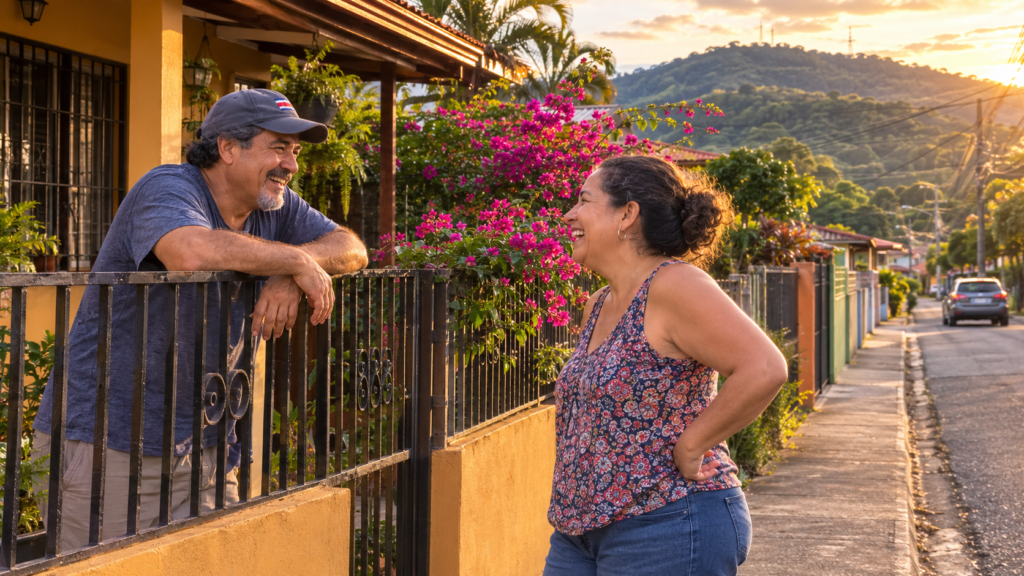
If you have spent more than twenty minutes researching a trip to Costa Rica, you have already encountered it. It appears on t shirts, coffee mugs, hotel check-in desks and the first line of almost every tourism website that covers the country. Pura vida. Translated literally, the phrase means pure life, and that translation is accurate in the same way that describing music as organized sound is accurate: technically correct and almost entirely useless for understanding what the thing actually is. The real meaning of pura vida is not found in a dictionary. It is found in the specific social situations where Costa Ricans reach for it, in the tone of voice they use when they say it and in the philosophy of daily life it has quietly encoded for decades.
The phrase did not begin as a marketing slogan. Its popularization in Costa Rica is generally traced to a 1956 Mexican film called Pura vida, which featured a cheerful, optimistic character who used the expression repeatedly despite facing one setback after another. Costa Rican audiences responded to that character’s attitude, and the phrase gradually entered everyday speech, not as borrowed dialogue but as a genuine expression of something the culture already recognized in itself. By the 1970s and 1980s it had become thoroughly Tico, and by the time international tourism began reshaping the country in the 1990s, pura vida was already the most natural thing a Costa Rican could say.
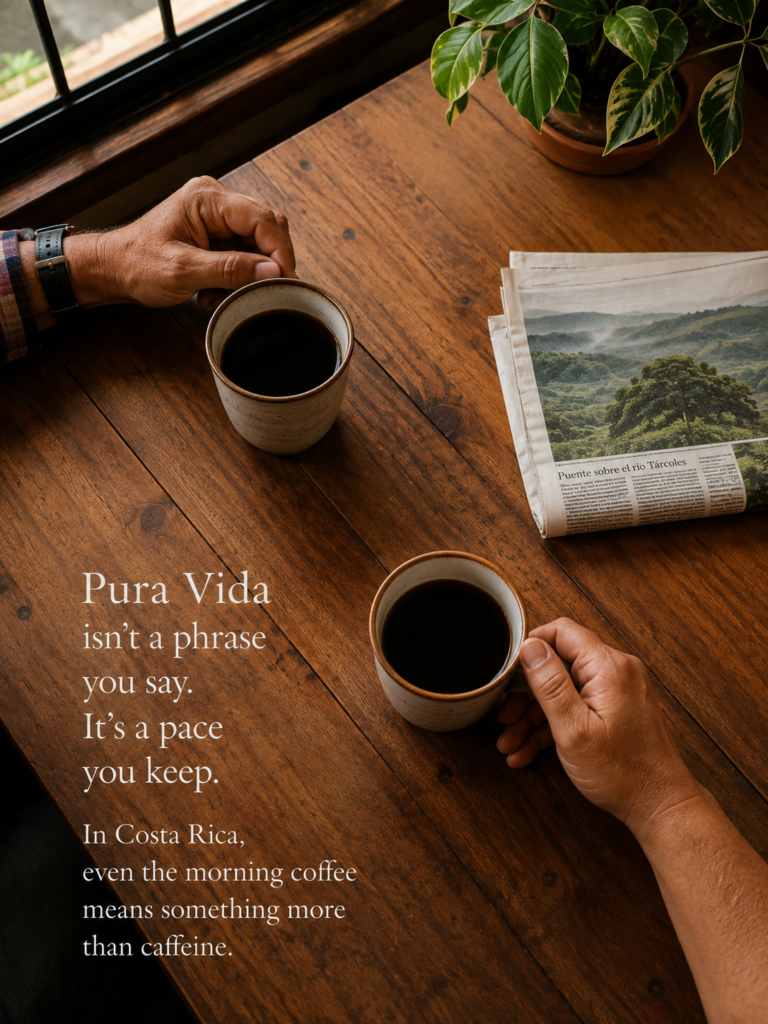
What makes the phrase linguistically unusual is that it functions as almost every part of speech simultaneously. It is a greeting: two strangers passing on a trail exchange a pura vida the same way an American might say hey. It is a farewell: the end of a phone call, the close of a transaction at a market stall, the last word at the door before a guest leaves. It is an answer to the question of how someone is doing, delivered with a tone that communicates genuine contentment rather than the reflexive fine that passes for an answer in many other cultures. It is an expression of gratitude, a way of saying everything is as it should be, a response to good news, and sometimes a quiet acknowledgment of bad news that cannot be changed. No single English phrase does all of those things at once.
At its most functional level, pura vida is a social lubricant. Costa Rican culture places high value on harmony and the avoidance of unnecessary tension, and the phrase serves that priority efficiently. When something goes wrong, a minor frustration, a small inconvenience, a plan that did not materialize, reaching for pura vida is not denial or forced positivity. It is a practiced cultural reflex that says: this is not worth making larger than it is. The phrase shrinks friction down to a manageable size. Foreigners who interpret this as indifference or passivity have misread the register. It is, in fact, a form of social intelligence, a way of keeping the temperature of daily life comfortable for everyone in the room.
The philosophical layer beneath the phrase is where most outside explanations fail to reach. Pura vida encodes a specific relationship with time, with productivity and with what constitutes a good day. In a country where the afternoon cafecito stops the workday, where Sunday lunch is a social institution that no appointment competes with, and where a neighbor who stops to talk is never an interruption, the phrase is both description and prescription. It describes a life in which presence matters more than efficiency. It prescribes a daily rhythm in which moments of connection are not squeezed between obligations but are themselves the point. This is not laziness dressed up in a slogan. It is a coherent value system that has kept Costa Rica ranking consistently among the happiest countries in the world by multiple independent measures.
It is also worth understanding what pura vida is not. It is not a guarantee that everything in Costa Rica runs smoothly, on time or without complication. Visitors who arrive expecting the phrase to correspond to frictionless service or perfect infrastructure will be confused. The roads have potholes. The buses run on their own schedule. Bureaucracy moves at a pace that can feel geological. Pura vida does not promise efficiency. It offers something different: a framework for not being destroyed by the absence of it. The Costa Rican who says pura vida after a frustrating wait at a government office is not pretending the wait was pleasant. They are choosing not to let the wait define the rest of the afternoon.
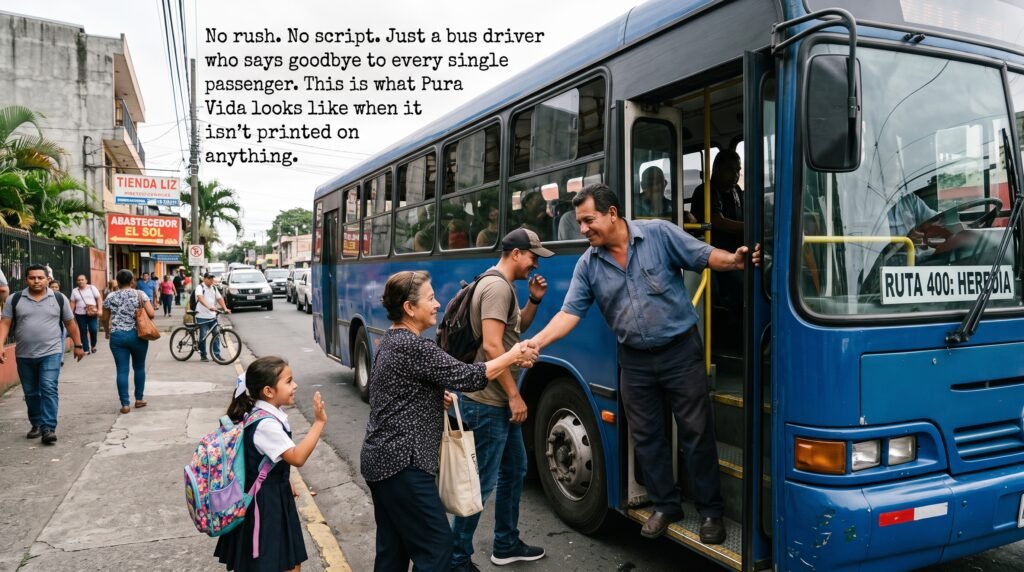
For tourists, the phrase creates an interesting asymmetry. Visitors use it as a two-word souvenir of the country, a phonetic keepsake to bring home and drop into conversation. Costa Ricans live inside it as an operating philosophy they rarely need to articulate because it shapes behavior before language gets involved. This gap is not a problem, but it is worth knowing about. The most meaningful way a visitor can engage with pura vida is not to say it more often but to recognize the moments when the culture around them is already practicing it: the bus driver who waits an extra thirty seconds for the elderly woman crossing the street, the soda owner who adds an extra spoonful to the plate without being asked, the stranger who gives ten minutes of unhurried directions to someone they will never see again.
The phrase also carries a class dimension that outside observers rarely discuss. Pura vida crossed from popular culture into national identity in a country with a historically strong middle class and a cultural narrative built around egalitarianism. When a university professor and a construction worker exchange a pura vida on the sidewalk, the phrase functions as a social equalizer, a shared code that acknowledges neither person’s relative position but their common membership in something larger. Tourism has layered a commercial veneer over this, and in beach resorts the phrase can feel performative. Step away from the tourist strip and it returns to its original function: ordinary, warm and entirely sincere.
Understanding pura vida properly changes how a trip to Costa Rica feels. It becomes less a destination to be consumed and more a country to be received on its own terms. The phrase is an invitation, extended by five million people to every visitor who crosses their border, to try a different relationship with daily life, one in which the afternoon matters as much as the morning, connection matters as much as productivity and the quality of a moment is not determined by how efficiently it was scheduled.
You do not have to agree with that philosophy to benefit from recognizing it. But if you spend a week in Costa Rica listening for the moments when pura vida is actually being practiced rather than printed on a shirt, you may find yourself leaving with something more useful than a souvenir: a question about your own relationship with time that the phrase, quietly and without insistence, has been asking all along.
Related Topics
Why Costa Rica Has One of the Happiest Cultures in the World
Why Are Costa Ricans So Friendly? The Cultural Reasons Behind the Warmth