
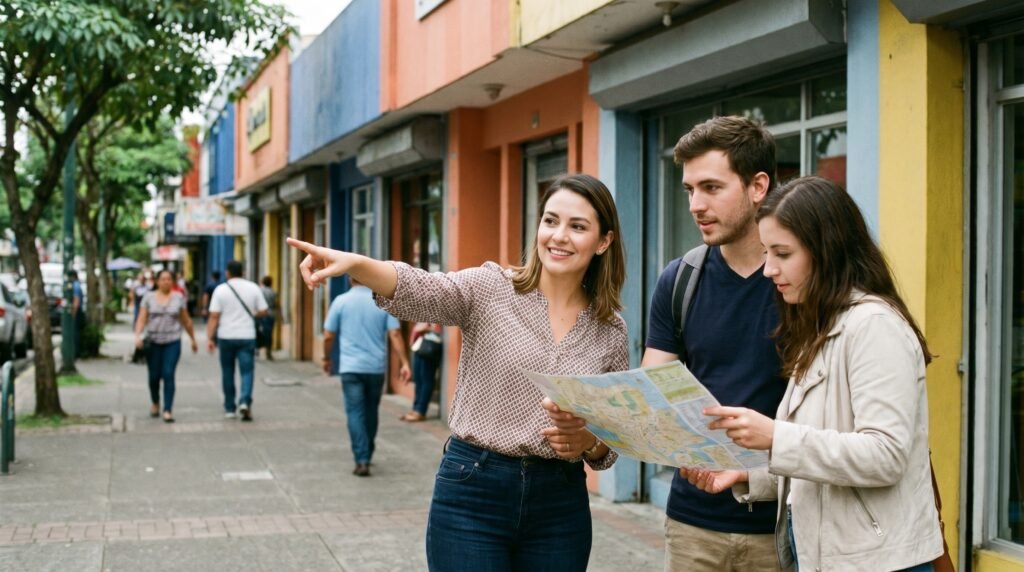
It is not an accident, not a performance, and not just a tourism strategy. Costa Rican friendliness has real roots historical, social, and deeply personal. A Tico explains where it actually comes from.
Almost everyone who visits Costa Rica comes back saying the same thing: the people were the best part. Not the beaches, not the volcanoes, not the wildlife the people. The bus driver who helped them find the right stop. The stranger who walked them three blocks out of their way to make sure they didn’t get lost. The family at the next table who ended up sharing their food and their Sunday afternoon without being asked.
It is easy to chalk this up to a tourism culture that has learned to be welcoming a professional warmth calibrated to the expectations of a three-million-visitor-per-year industry. But that explanation doesn’t hold up. The friendliness you encounter in Costa Rica happens in places tourists rarely go, between people who have nothing to sell you, in interactions that have no economic logic whatsoever.
So where does it actually come from? The answer is more interesting than “Ticos are just nice people” and more honest than “it’s all pura vida.” It involves history, social architecture, a specific relationship to community and conflict, and a set of values that were being practiced here long before the first zip line was ever installed.
I have lived in Costa Rica my entire life. I grew up watching this friendliness operate from the inside watching my mother stop to talk to a neighbor for forty-five minutes on the way to the supermarket, watching my father greet every person on a street he’d walked a thousand times as though each greeting mattered individually, watching strangers become temporary family at a bus stop because a conversation happened and nobody wanted it to end.
This is my attempt to explain, as clearly and honestly as I can, why Costa Ricans are the way they are and what that warmth is actually made of when you look at it closely.
There is a moment that happens to almost every foreigner who spends more than a few days in Costa Rica a moment when the friendliness stops feeling like a cultural feature and starts feeling personal. Someone goes out of their way for you in a manner so natural and unperformed that you find yourself caught off guard. Not because the act was dramatic. Because it wasn’t. It was ordinary. That ordinariness is the thing that stays with people long after they leave. Not a single extraordinary gesture from one extraordinary person but a consistent, ambient warmth that seems to come from everywhere and belong to everyone. That is the thing worth explaining. Where does it come from? Why is it so consistent? And is it real?
The short answer to the last question is yes, it is real. But real is not the same as simple, and the warmth that characterizes Costa Rican social life has layers that are worth understanding if you want to appreciate what you are actually receiving when a stranger treats you like a neighbor.
Six cultural roots of Costa Rican friendliness
A small country with a long memory for faces
Costa Rica has a population of just over five million people roughly the size of a mid-size American metropolitan area spread across a small country. The Central Valley, where most of those people live, is even more concentrated. This has a profound effect on social behavior. In a small society with high social density, the stranger you greet on the street today is statistically likely to be connected to someone you know your coworker’s cousin, your neighbor’s sister-in-law, someone who went to school with your mother. The social network is tight and the degrees of separation are few. In this context, treating strangers with warmth is not idealism. It is practical intelligence. You are almost certainly not speaking to someone who will remain a stranger for long.
The cultural architecture of conflict avoidance
Costa Rica has one of the most deeply embedded conflict-avoidance cultures in Latin America, a preference for social harmony so consistent and so practiced that it shapes the texture of almost every interaction. Warmth, in this framework, is not merely a personality trait. It is a social tool, the instrument by which friction is prevented, tension is dissolved, and the surface of daily life is kept smooth. When a Costa Rican greets you with warmth, part of what they are doing is signaling: I am not a threat. I am not here to create difficulty. I come in peace, genuinely. That signal, exchanged between strangers hundreds of times a day across the country, produces a social atmosphere that feels because it is distinctly low-aggression and high-ease.
The Catholic inheritance of hospitality as duty
Costa Rica is a majority Catholic country, and while formal religious practice varies widely by generation and region, the cultural imprint of Catholicism runs deep, particularly in its emphasis on hospitality as a moral value rather than a personal preference. The theological imperative to receive the stranger as you would receive Christ to extend generosity to those who have no claim on you, was instilled across generations as a genuine ethical commitment, not merely a social courtesy. That instinct has survived the decline of formal religious practice in many households precisely because it migrated from doctrine into character. The Costa Rican who offers you help without being asked is not thinking about theology. But the impulse has theological roots, and they are old.
A democratic and egalitarian social self-image
Costa Rica abolished its military in 1948, one of the most consequential and unusual decisions in the political history of Latin America. In the decades that followed, the country built a national identity around education, healthcare, environmental stewardship, and democratic participation. One of the values embedded in that identity is a particular form of social egalitarianism, a cultural resistance to the idea that some people are inherently more deserving of courtesy and respect than others. This is not perfectly realized in practice, Costa Rica has real class dynamics and real social stratification but the aspiration is genuine and widely felt. It produces a default register of warmth that is applied relatively democratically: to the foreigner and the local, the stranger and the neighbor, the professional and the day laborer. Everyone gets the greeting. Everyone gets the “con mucho gusto.”
“Costa Rican friendliness is not a performance calibrated for tourists. It is a social practice refined over generations, a way of moving through shared space that treats every encounter as worth the effort of being fully present.”
The family as the model for all social life
Costa Rican social structure is organized, at its foundation, around the family not the nuclear family of two parents and children, but the extended family of grandparents, aunts, uncles, cousins, godparents, and the dense network of obligations and affections that connects them. This is a culture where Sunday lunch at the grandmother’s house is a social institution, where family members drop by unannounced and are always fed, where the birth of a child or the death of an elder mobilizes entire networks of support without anyone needing to ask. The family, in this model, is the school in which Costa Ricans learn their social skills and what the family teaches is that showing up for people, feeding them, listening to them, and treating their presence as a gift rather than an imposition is simply what you do. Those lessons do not stay at the family table. They travel into every social interaction.
Pura vida as practiced philosophy, not marketing slogan
Pura vida is the most exported phrase in Costa Rican culture and, as a result, the most misunderstood. In its tourist packaging, it reads as a cheerful declaration of uncomplicated happiness a brand promise rather than a philosophy. In its actual cultural function, it is considerably more interesting. Pura vida is a commitment to presence over perfection, to the quality of the current moment over the anxiety of what comes next. When a Costa Rican says “pura vida” in response to a difficulty, they are not pretending the difficulty doesn’t exist. They are choosing not to let it define the emotional register of the interaction. That choice consistent, practiced, culturally reinforced produces people who are genuinely easier to be around, not because their lives are easier, but because they have developed a discipline of not exporting their stress onto the social surface. That discipline is felt by everyone in the vicinity. Including visitors.
The warmth that has limits
Honesty requires acknowledging that Costa Rican friendliness, like all cultural features, has its shadows. The same conflict-avoidance that produces warmth also produces the indirect communication that frustrates so many foreigners, the yes that means maybe, the “ahorita” that means eventually, the smile that does not always mean agreement. The hospitality that opens the door to a stranger can close, slowly and quietly, when that stranger overstays their welcome or fails to reciprocate with the gestures of care the culture expects in return.
Costa Rican warmth is also not equally distributed across all groups and pretending otherwise would be dishonest. Indigenous communities in Talamanca have complex and historically justified ambivalences about the warmth extended to outsiders. Afro-Caribbean communities on the Caribbean coast carry a different historical relationship with the dominant Central Valley culture that shapes how warmth is expressed and received. The friendliness of Costa Rica is real, but it is not monolithic, and it does not erase the social fault lines that exist beneath the warm surface of daily life.
What makes Costa Rican friendliness worth understanding rather than simply enjoying, is that it reflects a set of deliberate cultural choices. A small country that abolished its army, invested in education and health for all its citizens, and organized its social life around the family table produced a population that defaults to warmth not by accident, but by design. Even if the design was never explicit, even if no one voted on it, the choices accumulated over generations into a character. That character is what visitors experience. And it is, in the most meaningful sense, earned.
What the friendliness is actually asking of you
There is a dimension of Costa Rican friendliness that rarely gets discussed in travel content, and it is perhaps the most important one: it is not unconditional. It is an invitation to a reciprocal exchange. When a Costa Rican greets you warmly, holds the door, offers directions, shares their table, or makes space for you in a conversation, they are extending a social gesture that belongs to a system of mutual generosity. That system functions because everyone participates. The warmth flows because it is returned.
Visitors who receive Costa Rican friendliness as a service as something the culture provides for their comfort are misreading the exchange. The correct reading is: this person is treating me as a member of their community, temporarily but genuinely, and the appropriate response is to act like one. That means greeting back with the same attention. It means saying thank you in a way that registers. It means not rushing past a conversation to get somewhere else. It means understanding that the warmth you are receiving represents an actual expenditure of social energy by an actual person who chose to spend it on you.
When visitors make that choice in return, when they slow down enough to actually participate in the exchange rather than simply benefit from it something shifts in how Costa Rica feels. It stops being a country you are moving through and becomes, for the duration of that interaction, a place you briefly belong to. That is a different travel experience entirely. And it is available to anyone willing to return the greeting.
Why it matters that you understand this
Understanding where Costa Rican friendliness comes from changes how you receive it. It transforms a pleasurable but passive experience, nice people, nice country into something more layered and more instructive. You begin to notice the specific forms the warmth takes: the individual greeting, the patient explanation, the refilled coffee cup, the offer of food before you knew you were hungry. You begin to understand that each of these is not random generosity but a practiced expression of values that were formed over centuries and are being renewed every day by millions of people making small choices about how to treat each other.
And you begin, perhaps, to ask yourself what those choices look like from your own side of the exchange. Not as a tourist obligation, but as a genuine human question: what would it mean to move through the world the way Costa Ricans do with the default set to warmth, the register calibrated to ease, the assumption being that the person in front of you is worth the effort of a real greeting?
Costa Rica doesn’t export that question directly. But spend enough time here, surrounded by people who have answered it with their daily behavior for their entire lives, and it tends to surface on its own.
That may be the most valuable thing you bring home from this country. More than the coffee, more than the photographs, more than the memory of the wildlife. The question of what it would cost you to be a little more like this and what it might give back.