
Wood, Clay, and Color
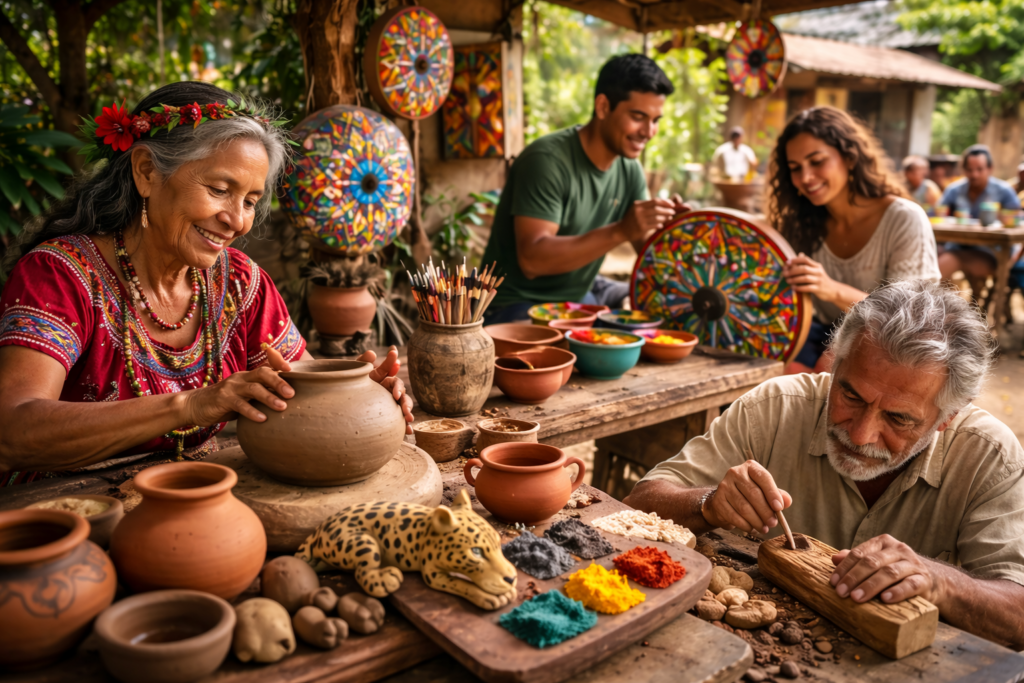
In Costa Rica, culture is not only spoken—it is carved, molded, and painted. Wood, clay, and color have shaped the country’s artistic identity for generations, connecting communities to their land and ancestry. From hand-carved ox carts to Indigenous pottery and vividly painted festival decorations, traditional materials tell stories of resilience, craftsmanship, and environmental respect. These elements are not relics of the past; they remain alive in homes, markets, and modern design spaces across the country. Step into the world of Costa Rican craftsmanship and discover how natural materials continue to express cultural pride and belonging.
Curious about the stories hidden in wood grain, clay textures, and vibrant color?
The Heart in Our Hands: The Hidden Soul of Costa Rican Craftsmanship
In Costa Rica, when we say something is “handmade,” we aren’t merely describing a method of production. We are referencing an act of resistancea whisper from our ancestors that refuses to be silenced by the cacophony of modernity. For us, craftsmanship is not a mere souvenir to pack into a suitcase; it is the genetic map of our identity, etched into balsa wood or painted with the vibrant hues of a volcano.
The Song of the Wood and the Peasant’s Pride
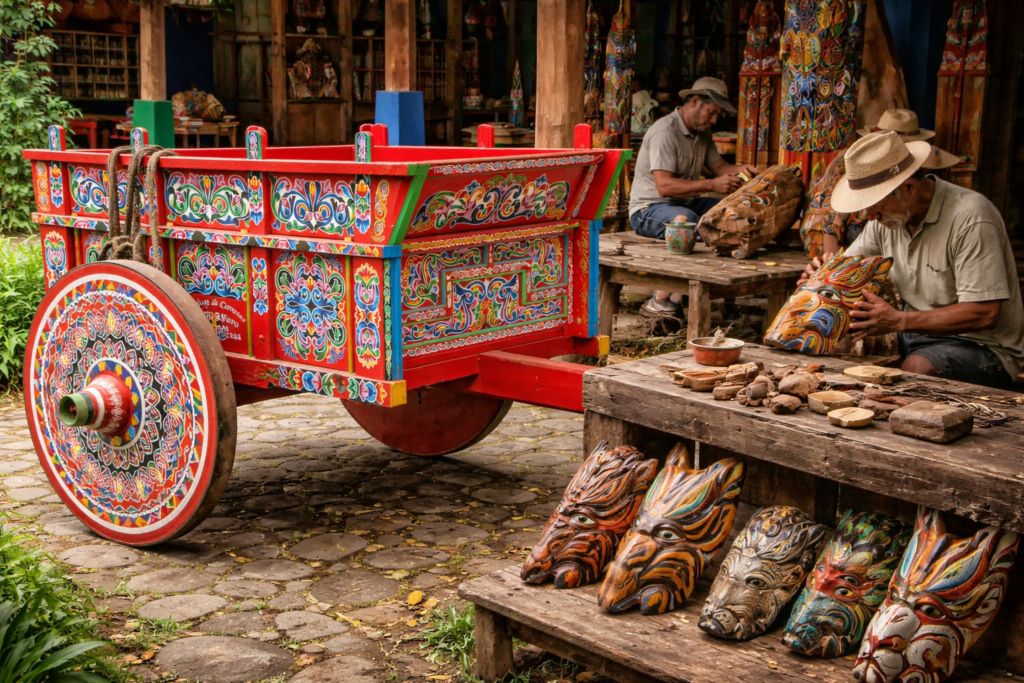
If there is one thing that defines the spirit of the Central Valley, it is the hand-painted oxcart wheel. But let us pause for a moment. The carreta pintada, far beyond being the icon found on postcards in Sarchí, is a monument to the toil of our forebears.
Historically, the oxcart was the sole livelihood of the coffee-farming family. Yet the Costa Rican, in an innate drive to find beauty even in the hardships of the field, decided that their tool of labor should be magnificent. Painting an oxcart was not an act of vanity; it was a declaration of dignity. Each family developed its own unique motifs kaleidoscopic stars and floral patterns creating a visual language that allowed neighbors to identify one another from a distance. And then, there is the “song.” That rhythmic, metallic chime of the iron rims striking the wooden axle is not noise; it is the music of labor. To a true Tico, the silence of an oxcart signifies abandonment; its song, conversely, is the voice of a people on the move.
Boruca: Wood That Screams Resistance
Moving south toward the lands of the Boruca people, craftsmanship transcends the utilitarian and enters the realm of the mystical. The “Diablitos” masks are perhaps the rawest and most vibrant expression of our resilience.
When you look upon a Boruca mask, you are not seeing a wall ornament. You are seeing the face of a people who were never truly conquered. During the colonial era, Indigenous groups used these masks to terrify invaders, personifying the spirits of nature. Today, as a Boruca artisan carves cedar or balsa wood, they are fighting that same battle: to keep their language, their forests, and their right to be different alive. Every stroke defining a jaguar or a macaw is a reminder that our true wealth lies not in a bank, but in the mountains that cradle us.
The Clay of Guanacaste: Earth’s Living Memory
In the north, within the communities of Guaitil and San Vicente, art is not carved; it is kneaded. Here, Chorotega pottery serves as an umbilical cord connecting us to our Mesoamerican roots. The most profoundly human aspect of this tradition is its stubbornness: artisans still seek out “curiol,” a specific stone found in the hills, to extract the natural red, black, and cream pigments.
Crafting pottery in Guanacaste is an exercise in humility. It is the understanding that we come from the earth and to it we shall return. There are no electric wheels here; there are only hands dancing over clay as they have for a millennium. When you hold a Chorotega vessel, you are touching the same dust trodden by ancient chieftains. The motifs of the Great Pava or the lizard are not mere decoration; they represent a deep-seated reverence for a fauna that our ancestors deemed sacred. It is a lesson in patience for a world that has forgotten how to wait.
More Than Objects: Narratives of a Lifetime
What the world often overlooks is that behind every etched gourd or hand-woven basket stands a person with calloused hands and a story to tell. In Costa Rica, the artisan is not a mass-producer; they are a guardian.
- They are the grandmother weaving cured thread while tending to her grandchildren, passing down knowledge without the need for a manual.
- They are the woodworker who waits for the moon to reach the correct phase before felling timber, respecting the biological cycles that modern science sometimes ignores.
- They are the young person who, instead of migrating to the city, chooses to remain in their village so that their father’s trade does not die with him.
Conclusion: The Heritage of Identity
Costa Rican craftsmanship is our way of saying, “We are here.” It is the reflection of a country that, while small in territory, is a giant in its capacity for creation. It is not about the mathematical symmetry of a brushstroke, but the intention behind it.
Ultimately, the cultural significance of our crafts is connection. It is a connection to an Indigenous past, to the peasant’s struggle, and to the exuberant nature that surrounds us. It is a reminder that we are a people who choose peace, who value the fine detail, and who, above all, put our hearts into everything we touch.
In Costa Rica, craftsmanship cannot be bought with money; it must be understood with the soul. It is our essence—molded, painted, and carved—so that time itself cannot wash it away.