
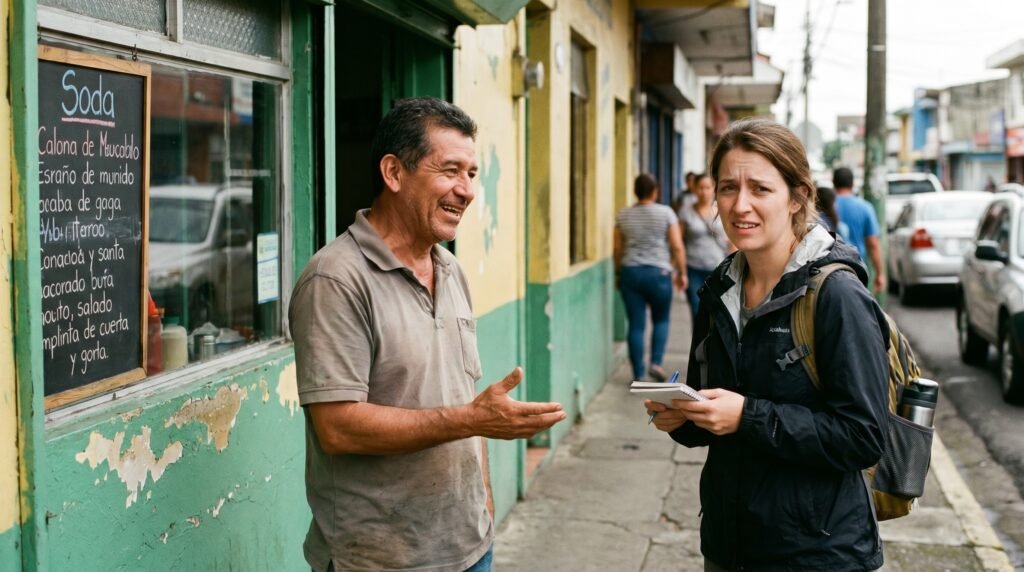
It happened to me too, and I’m the one from here. A colleague once asked me to help him understand why his Costa Rican landlord had told him three times that the broken water heater would be fixed “this week” and three weeks had passed without a single visit from a plumber. He wasn’t angry, just genuinely confused. “He seemed so sincere,” my colleague said. I nodded. Because the landlord probably was sincere. That’s precisely the part that’s so hard to explain.
I am a 35-year-old Costa Rican man. I grew up in Heredia, in a household that was warm, crowded, and allergic to awkward silences. I work in a mid-sized company in San José, I’ve had foreign colleagues and friends for years, and I’ve watched this particular misunderstanding play out dozens of times always with the same confused expression on the foreign side and the same well-intentioned evasion on ours. So let me try to explain something that most Costa Ricans won’t explain to you, partly because we don’t think about it consciously, and partly because explaining it would require saying something uncomfortable.
It’s not dishonesty. It’s something older than that.
The first thing you need to understand is that what you’re experiencing is not lying. I want to be very clear about this. When a Costa Rican tells you “yes, of course, no problem,” they are not looking you in the eye and thinking the opposite. In that moment, they genuinely want things to work out. They want you to be happy. They want the interaction to end well. The problem is that what they’re prioritizing is the harmony of the present moment not the accuracy of what they’re promising about the future.
We have a deep, almost instinctive aversion to conflict. It runs through our culture like a quiet current beneath everything. It shows up in how we argue, how we disagree, how we fire employees, how we end relationships. Direct confrontation even gentle, reasonable, adult confrontation produces in most Costa Ricans a kind of emotional discomfort that is very hard to describe to someone who didn’t grow up with it. Saying “no” to your face, in that moment, with your eyes on us, feels like inflicting a small wound. And we would rather carry the burden of an unfulfilled yes than cause you that pain right now.
This is not weakness. It is, in a strange way, a form of care. Misguided care, perhaps, by the standards of more direct cultures but care nonetheless. Understanding this distinction changes everything about how you interpret what happens next.
The vocabulary of the soft no
Once you know what you’re listening for, the real answer becomes audible. There is an entire vocabulary of evasion in Costa Rican Spanish that functions as a polite no, and most foreigners walk right past it because it sounds like encouragement. Let me walk you through the most common signals.
“Ahorita” is perhaps the most famous. It technically means “right now,” but in practice it means “at some point in the near future that I am not prepared to specify.” If someone says they’ll do something “ahorita,” it means it’s on their radar but not necessarily their calendar. “Ahorita” can mean five minutes from now or five days from now, and the difference depends entirely on context, tone, and the relationship between the two people speaking.
Then there’s “vamos a ver,” which translates to “we’ll see.” In the English-speaking world, “we’ll see” is something you say when a decision is genuinely pending. In Costa Rica, “vamos a ver” often means the decision has already been made and the decision is no. It is a compassionate no, a no that keeps the door technically open so that neither party has to experience the discomfort of closure.
“Tal vez”, “maybe”, functions similarly. And perhaps most importantly, there are the yeses that come too quickly, too easily, with too much warmth and too little specificity. If you ask whether something is possible and the answer arrives before you’ve finished asking the question, with a wide smile and no follow-up questions, pay attention. A real yes in Costa Rica usually comes with conditions, clarifications, and logistics. An eager, unqualified yes, especially to something complicated, deserves a second look.
Why this matters more than you think
I’ve seen this pattern derail business negotiations, frustrate expats who are trying to get home repairs done, leave tourists standing on a street corner waiting for a guide who had no intention of showing up, and quietly damage friendships between Costa Ricans and foreigners who genuinely liked each other but couldn’t bridge this particular gap. The stakes are not always small.
And the frustrating part the part that genuinely keeps me up at night when I think about how my country is perceived is that it is almost never malicious. The person who told you yes was not trying to deceive you. They were trying to give you what felt, in that moment, like the kindest possible response. The problem is that kindness expressed through vagueness creates a very specific kind of pain on the receiving end: the pain of false expectation.
What you can actually do about it
The most effective thing I have seen foreigners do and this is based on watching real interactions, not reading communication theory is to remove the social cost of the honest answer. Make it easy to say no. Instead of asking “Can you do this?” ask “Is this realistic given your current schedule, or should we talk about a different timeline?” Instead of “Will you be there?” try “If something comes up, just let me know and we’ll reschedule no problem at all.” When you genuinely and visibly remove the pressure to perform a yes, you often get the real answer.
You can also learn to read the room differently. Pay attention to logistics. A real yes comes with details: time, place, confirmation. A social yes floats. If after saying yes someone immediately changes the subject, adds a vague qualifier, or fails to ask any follow-up questions about the practicalities slow down and gently probe.
And finally and I say this as someone who grew up inside this culture don’t take it personally. This pattern has nothing to do with how much someone values you or respects your time. It is a deeply conditioned social reflex, one that many Costa Ricans apply even to people they genuinely care about. My own father once told me he’d come to an event he had no intention of attending. Not because he didn’t love me. Because saying no, in that moment, felt like the less loving option.
The bigger picture
Understanding this one cultural pattern unlocks a great deal of what can feel confusing or opaque about Costa Rica. The indirectness around conflict, the flexibility around time, the way plans shift without formal cancellation these are all expressions of the same underlying value: social harmony as a daily practice, not an occasional achievement.
Costa Rica is a country that decided, a long time ago, to prioritize peace. We abolished our army in 1948. We settle most things with conversation rather than confrontation. We smile at strangers and mean it. But that same impulse toward harmony that instinct to keep the surface smooth is also why we sometimes say yes when we mean something far more complicated.
Once you understand the “why,” the “what” stops feeling like a personal affront and starts feeling like a cultural texture. One you can learn to read. And once you can read it, Costa Rica gets significantly easier and significantly more interesting to navigate.
Jose.