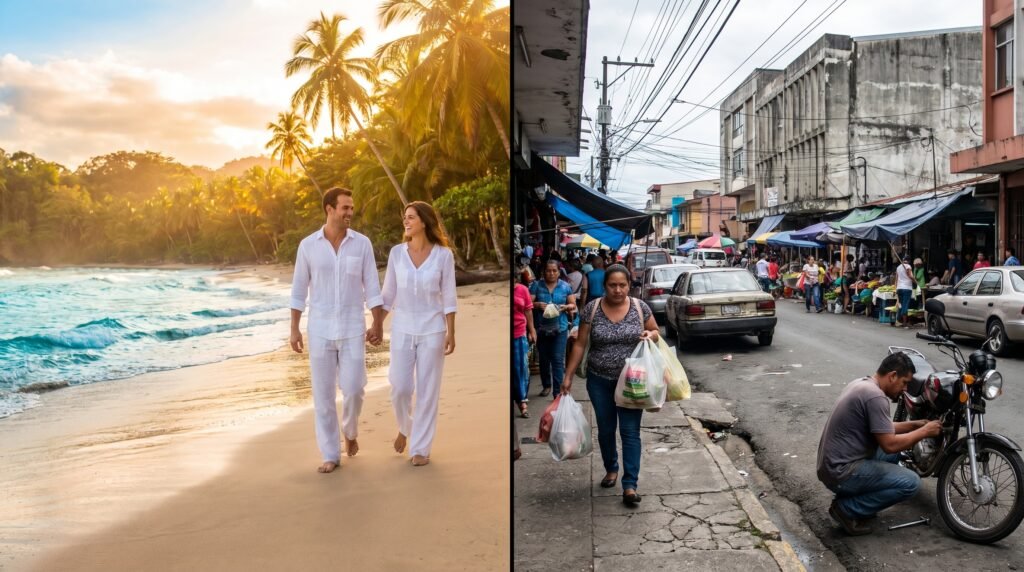
Afew months ago, a tourist stopped me on a street in Heredia my city, a place I have lived my entire life and asked if I could recommend somewhere “authentic.” He had been in the country for four days. He had stayed in a boutique hotel in La Fortuna, done the hot springs, done the volcano, done the coffee tour, and now he was in the Central Valley for a day before flying home. He wanted, in his words, “to see how real Costa Ricans actually live.” I looked at him for a moment. He was standing on a real Costa Rican street. Real Costa Ricans were walking past him in both directions. A real Costa Rican woman was selling tamales from a cooler ten meters behind him. I pointed at the street. He looked confused. I think he was expecting me to point at a jungle.
That exchange has stayed with me because it captures, in a single moment, the central problem with how most tourists experience this country. They arrive with a version of Costa Rica already assembled in their heads — built from travel websites, Instagram feeds, Netflix documentaries, and the recommendations of friends who also only saw fifteen percent of the place. That version is not false, exactly. But it is radically incomplete. And the incompleteness is so consistent, so patterned, that after a while you can predict exactly which myths a given tourist is carrying just by listening to them for five minutes.
Here, with as much honesty as I can manage about my own country, is what most tourists think Costa Rica is and what it actually is.
Costa Rica is basically all jungle and beaches
The myth
An endless green wilderness of tropical forest, punctuated by perfect Pacific beaches. Nature everywhere, all the time, unspoiled and accessible.
The reality
A mostly urban country where the majority of the population lives in a densely populated Central Valley of concrete, traffic, strip malls, and fast food chains surrounded by mountains.
Let me give you a number: over sixty percent of Costa Rica’s population lives in the Greater Metropolitan Area San José and the surrounding cities of Alajuela, Heredia, and Cartago. This is a region of traffic jams, shopping malls, university campuses, industrial parks, call centers, and neighborhoods that look, if you squint, not entirely unlike the suburbs of any mid-size Latin American city. It is not what anyone pictures when they google “Costa Rica.”
The forests are real. The beaches are real. The biodiversity is genuinely staggering this small country holds nearly six percent of the world’s species on less than 0.03 percent of the planet’s surface. But the Costa Rica that most Costa Ricans actually inhabit on a daily basis is not the rainforest. It is a gridlocked highway at seven in the morning, a crowded bus, a supermarket parking lot, a concrete apartment block with a mountain view if you’re lucky. The natural splendor exists. It just doesn’t represent the whole country, or even most of it.
Everyone lives a slow, relaxed, pura vida lifestyle.
The myth
A population of cheerful, unhurried people who have found the secret to stress-free living and want nothing more than to share it with visitors.
The reality
A working population under significant economic pressure, navigating the same stresses of housing costs, healthcare, employment, and family that people face everywhere with a particularly gracious social surface on top.
I need to be careful here, because I am not saying Costa Ricans are secretly miserable. We are not. There is genuine warmth in the culture, genuine humor, genuine resilience, and a real tendency toward social ease that I believe is one of the most attractive qualities of the place. But the tourist reading of “pura vida” as a philosophy of effortless contentment, practiced by a population of naturally relaxed people flattens something that is much more interesting and much more human.
The average Costa Rican family is working hard. Housing prices in the Central Valley have risen dramatically in recent years. The cost of living is not trivial. Many people work two jobs. Traffic adds two or three hours to the daily commute of hundreds of thousands of workers. The public health system, while genuinely good, requires patience that would test anyone. Pura vida, in this context, is not a description of how life feels. It is a coping mechanism. A collective agreement to lead with warmth even when things are difficult. That is actually more admirable than the myth but it is a different thing entirely.
“Pura vida is not a description of how life feels. It is a coping mechanism a collective agreement to lead with warmth even when things are hard. That is more admirable than the myth, but it is a different thing.”
Costa Rica is a safe, easy paradise to navigate
The myth
The Switzerland of Central America politically stable, peaceful, well-organized, and effortlessly navigable for any English-speaking visitor.
The reality
A country that is genuinely more stable and democratic than most of its neighbors, but that has real and growing urban crime, significant infrastructure gaps, and a bureaucratic complexity that humbles even the most prepared traveler.
Costa Rica’s reputation for safety and stability is not unearned. We have been a democracy without interruption since 1949. We abolished our military that same year. We have a free press, an independent judiciary, and a long tradition of peaceful political transitions. By regional standards and by many global ones this is a genuinely stable country, and that stability is something Costa Ricans are rightly proud of.
But stability is not the same as ease, and democratic tradition is not the same as low crime. Urban theft phone snatching, bag grabbing, opportunistic robbery has increased in San José and in popular tourist areas over the past decade. Certain neighborhoods require the same common-sense caution you would apply in any large Latin American city. Roads outside the main highways are often in poor condition, badly signed, and genuinely dangerous at night. The rainy season, which lasts roughly half the year, can make certain routes impassable and certain plans impossible.
None of this should dissuade anyone from visiting. But the tourist who arrives expecting the frictionless infrastructure of a European destination will find themselves caught off guard by the potholes, by the absence of reliable addresses (Costa Rica famously uses landmark-based directions rather than street names and numbers), and by the occasional reminder that this is a developing country with a developing country’s relationship to logistics.
The wildlife is everywhere and easy to see
The myth
Monkeys swinging through the trees above your hotel, sloths hanging from every branch, toucans landing on your breakfast table. Biodiversity delivered on demand.
The reality
Wildlife that is genuinely extraordinary but that requires patience, the right locations, the right time of day, and ideally a knowledgeable local guide to actually encounter in any meaningful way.
The biodiversity is real let me be absolutely clear about that. Costa Rica contains an astonishing concentration of species, and a well-planned trip with good guiding can produce wildlife encounters that will genuinely change how you see the natural world. I have lived here thirty-five years and I still occasionally stop in my tracks when I spot something I’ve never seen before.
But the tourist who spends a week in the most popular destinations and expects the forest to perform for them who is vaguely disappointed not to have seen a jaguar or a tapir or a resplendent quetzal on their morning walk has confused density of species with ease of encounter. Many of Costa Rica’s most spectacular animals are nocturnal, shy, rare, or confined to specific habitats that require real effort to reach. The animals you reliably see easily the white-faced capuchins begging for food near the beach, the iguanas sunbathing on hotel walls are the ones that have adapted to tourist presence. The truly wild encounter requires going where tourists mostly don’t go, at hours tourists mostly don’t wake up, with a guide who knows the difference between a trail and a path.
The locals love tourists and want to share their culture
The myth
A warmly welcoming population, universally delighted by foreign visitors and eager to share the secrets of their culture with anyone who asks.
The reality
A population with genuinely complex feelings about tourism grateful for the economic activity it generates, and quietly exhausted by the version of their country it tends to demand.
Costa Ricans are warm. I have said this before and I mean it. But warmth does not mean unlimited enthusiasm for the tourist gaze, and the assumption that it does that the local is always available, always willing, always performing their culture on request is one of the more quietly insulting things about how tourism often operates here.
The woman weaving a basket in a craft market is not an exhibit. She is a person with a mortgage and a daughter with homework and an opinion about the weather. The family eating Sunday lunch at the soda near the national park did not come there to be photographed. The guide who has explained the same zip line safety procedures twelve times today deserves to be addressed as a person, not a service function. Costa Rican hospitality is genuine and it is generous. It is also not inexhaustible, and the tourists who treat it as a given who assume the warmth is there for their consumption, rather than being something they should earn and reciprocate are taking more than they realize.
The Costa Rica that most tourists leave having experienced is a curated one comfortable, beautiful, and real in its own way. The Costa Rica that exists alongside it, and behind it, and underneath it, is considerably more layered. Both are worth knowing. Only one of them is currently on the brochure.
Costa Rica is an environmentally pristine country
The myth
A global model of environmental stewardship a country that has figured out how to live in harmony with nature and leads the world in conservation.
The reality
A country with a genuinely impressive conservation record that also has significant problems with plastic waste, water contamination in some rural areas, unregulated construction in ecologically sensitive zones, and the environmental contradictions that come with a mass-tourism economy.
Costa Rica’s environmental reputation is, in important ways, deserved. The country reversed dramatic deforestation in the 1980s and now has forest cover approaching sixty percent of national territory, one of the great conservation success stories of the twentieth century. The national park system is extensive and genuinely well-protected. The country runs on over ninety percent renewable electricity. These are real achievements and they represent real political will, sustained over decades, across multiple administrations.
But the environmental Costa Rica that tourists imagine clean rivers, spotless beaches, a population in ecological communion with its natural surroundings runs into some sharp edges on contact with reality. Plastic waste in rivers and on roadsides is a persistent and visible problem. Several popular beach towns have water quality issues during heavy rainfall. Construction in coastal and mountainous areas frequently outpaces environmental regulation. And the tourism industry itself with its fleets of four-wheel drives, its single-use plastic bottled water, its constant pressure on the most biodiverse and fragile ecosystems is not without its own ecological footprint.
None of this negates what Costa Rica has achieved. But the tourist who arrives expecting to find a perfectly resolved relationship between human activity and natural environment will instead find a country that is genuinely trying, meaningfully succeeding in some areas, and still very much working it out in others. Which is, I think, a more honest and more interesting story than the pristine paradise version and a more useful one for anyone who actually wants to engage with the place rather than just consume it.
What the real Costa Rica is actually worth
Here is what I want tourists to understand, after all of this: the real Costa Rica the complicated, contradictory, loud, frustrating, genuinely beautiful, politically proud, economically strained, culturally rich actual country is more interesting than the postcard. Not despite its contradictions, but because of them. A country that abolished its army, rebuilt its forests, and answers almost everything with “pura vida” while simultaneously navigating the same messy human pressures as everywhere else that is a story worth paying attention to.
The tourists who come away with that story are the ones who slowed down long enough to notice it. Who got off the resort shuttle and onto a public bus. Who ate at the soda instead of the restaurant with the English menu. Who asked a local a question and then waited through the whole answer. Who let Costa Rica be a country rather than a backdrop.
That version of travel is available to anyone who wants it. It just requires trading the postcard for a slightly less comfortable, considerably more rewarding picture. The one that looks like a street in Heredia, on an ordinary Tuesday, with tamales for sale from a cooler on the sidewalk and a tourist standing in the middle of real life, finally starting to see it.