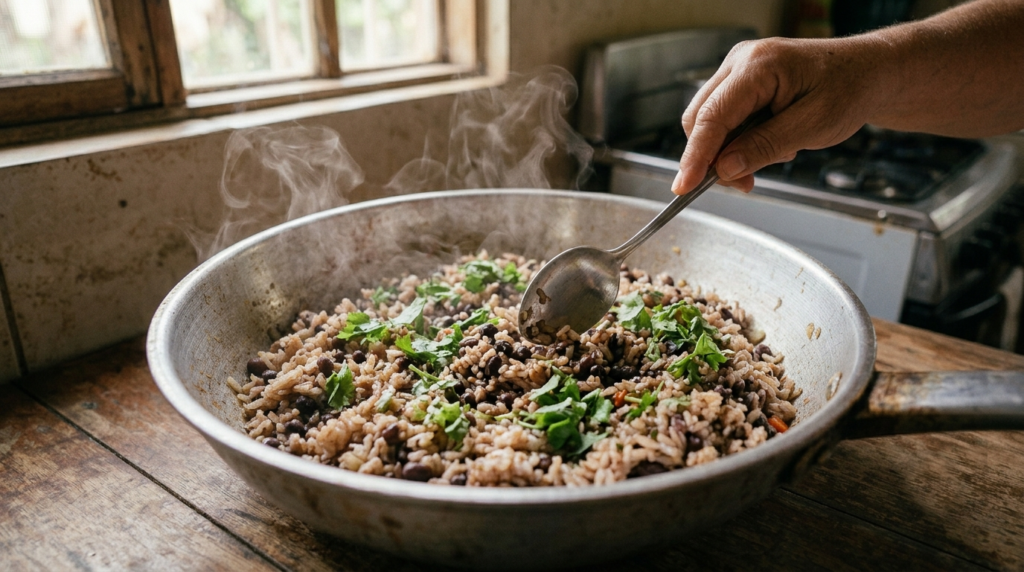
There is a moment that happens to almost every visitor on their first morning in Costa Rica. They sit down for breakfast, expecting fruit or toast or maybe scrambled eggs, and what arrives instead is a generous scoop of rice and beans, dark and fragrant, sitting confidently at the center of the plate. Before any questions can be asked, the smell reaches them: something savory and slightly smoky, with a faint herbal note and a warmth that feels more like home cooking than hotel food. That dish is gallo pinto, and for the vast majority of Costa Ricans, a morning without it is simply not a complete morning.
Gallo pinto translates literally as spotted rooster, a name that refers to the speckled appearance of the dish once the black beans and white rice are mixed together. The visual effect is exactly what the name suggests; dark beans scattered through pale rice, the colors blending unevenly so that no two spoonfuls look quite the same. It is one of those names that makes more sense once you see the dish than it does on paper, and it has been part of the country’s culinary vocabulary for long enough that most Costa Ricans never stop to think about where the phrase came from.

The preparation begins with rice and black beans that have already been cooked, usually the day before. Leftover rice is not a shortcut in Costa Rican cooking; it is an ingredient with specific properties. Day old rice has dried slightly, which means it will fry rather than steam when it hits a hot pan, giving each grain a subtle texture that fresh rice cannot replicate. The beans arrive with some of their cooking liquid, known as caldo, which deepens the color of the rice as everything cooks together. Without that caldo, the dish looks lighter and tastes flatter; the liquid is not optional.
Into the pan go diced white onion and sweet pepper, sautéed in oil until soft, followed by the rice and beans together. The key moment is the addition of Salsa Lizano, a thin, slightly sweet and tangy condiment that Costa Rica has been producing since 1920 and that has no real substitute anywhere in the world. Salsa Lizano is made from vegetables, spices and a proprietary blend that gives gallo pinto its most distinctive flavor note; the one that visitors cannot quite identify but find themselves craving again the following morning. Without it, the dish is competent; with it, it is unmistakably Costa Rican.
Fresh culantro coyote, a herb related to cilantro but more pungent and slightly more bitter, is added at the end of cooking along with finely chopped white onion for brightness. The result is a dish that smells more complex than its ingredients suggest, savory and herbal with a faint sweetness from the salsa and a satisfying depth from the bean caldo. Served immediately from the pan, it arrives at the table with a slight crust on the bottom layer of rice and beans that many consider the best part.
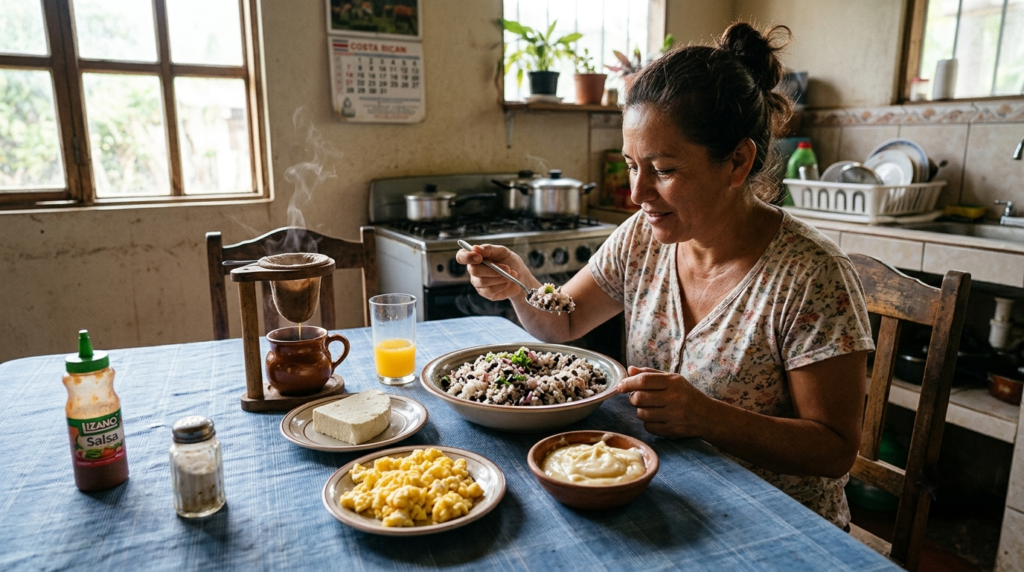
A full Costa Rican breakfast builds around the gallo pinto rather than beside it. Scrambled or fried eggs arrive on the same plate, along with sliced natilla, a thick, slightly sour local sour cream that melts slowly into the hot rice and beans. A wedge of queso blanco, firm and mild, often sits alongside. Toast with butter or a fresh tortilla de maiz completes the arrangement, with a cup of café chorreado, strong filter coffee poured through a cloth sock, waiting nearby. This combination, eaten unhurriedly at a kitchen table or a soda counter, is what mornings in Costa Rica look like for millions of people across the country.
The cultural weight of gallo pinto goes well beyond nutrition. It is one of the few dishes that Costa Ricans from every income level, every region and every generation share without variation. A gallo pinto eaten at a five star hotel buffet in Escazú and a gallo pinto eaten at a grandmother’s kitchen table in Nicoya taste different because the hands that made them are different, but the logic of the dish is identical. That consistency functions as a kind of daily national ritual, a quiet reaffirmation of identity that happens before most people are fully awake.
There is also an ongoing, mostly good natured debate between Costa Rica and Nicaragua about which country can rightfully claim the dish as its own. Both nations eat it daily, both call it gallo pinto and both defend their version as the original with equal conviction. The Costa Rican version leans on black beans and Salsa Lizano; the Nicaraguan version more commonly uses red kidney beans and has a slightly different flavor profile. Food historians have not resolved the debate and likely never will, which suits both countries perfectly. Pride in gallo pinto, it turns out, is one more thing the two nations have in common.
Gallo pinto also travels well within the country without losing its identity. From Guanacaste to San José to the Caribbean coast, the base of the dish stays consistent even when the breakfast that surrounds it shifts slightly by region. Near Limón, a plate of gallo pinto might arrive alongside fried plantains and a cup of ginger tea rather than the classic café chorreado. In mountain towns, a thicker corn tortilla replaces the toast. The dish absorbs local context without ever losing its essential character, which may explain why it has outlasted every food trend that has passed through the country over the past century.
For visitors, the morning encounter with gallo pinto tends to go one of two ways. Some find it unfamiliar to the point of discomfort, conditioned by years of sweet breakfasts or meals that keep savory flavors reserved for later in the day. Others take a single bite and immediately understand why Costa Rica has never seen any reason to change its morning routine. Both reactions are valid, and both are recognized by locals who have watched tourists navigate the breakfast plate for decades.
The most useful thing a visitor can do is try it twice before forming an opinion. The first serving might feel like an adjustment; the second usually starts to feel like something worth seeking out. By the third morning, ordering gallo pinto is no longer a cultural experiment but simply breakfast, which is exactly how it has always functioned for the people who grew up eating it.
Gallo pinto is not trying to impress anyone. It has no origin story polished for tourism, no celebrity chef endorsement and no fusion version designed to make it more appealing to outside palates. It exists because it works: affordable, filling, nutritious and deeply satisfying in the uncomplicated way that only a dish made from a few honest ingredients, cooked with routine confidence, can be. Every morning in Costa Rica, millions of pans heat up at roughly the same hour; the smell is always the same, and the day always begins a little better for it.
Would you like to try it? Here’s the recipe.
Gallo Pinto: The Authentic Costa Rican Recipe (Simple and Step-by-Step)
This recipe relies on the principle of using rice and beans cooked the day before, which gives it its perfect texture. There are no exact measurements; it’s all about taste and “by eye”!
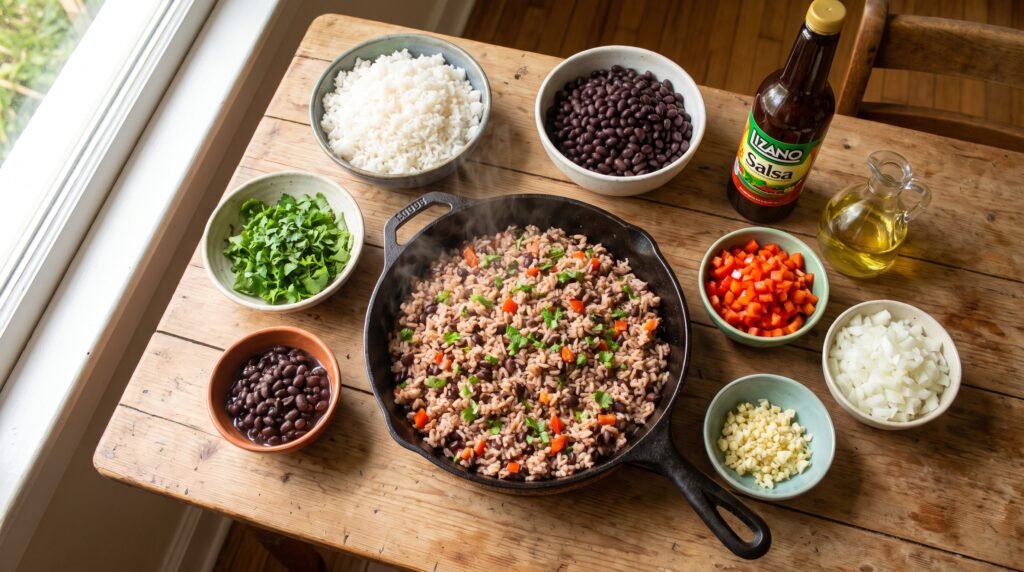
Ingredients (for 2-3 people):
- Day-old cooked rice: 2-3 cups (it’s crucial that it’s cold and dry).
- Cooked black or red beans (with their “broth”): 1.5 – 2 cups (black beans are more common in the Central Valley; red beans are popular on the coasts, but both are authentic).
- Onion: 1/2 medium, finely chopped.
- Bell pepper (sweet red or green): 1/2 medium, finely chopped.
- Fresh cilantro: To taste (a good handful), chopped.
- Garlic: 1-2 cloves, finely chopped (optional, but recommended).
- Lizano Salsa: To taste (the secret and indispensable ingredient).
- Vegetable oil or lard: For frying.
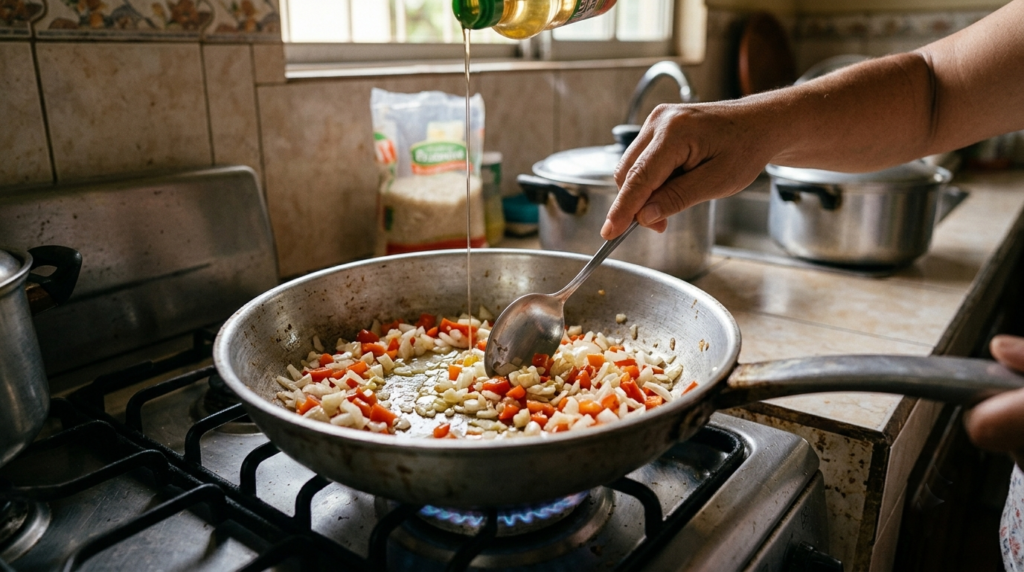
Step 1: The Sauté (Sofreído) — The Foundation of Flavor
The secret to a great Gallo Pinto begins with a slow, aromatic “sofrito.” Do not rush this step; we want the vegetables to release all their sweetness.
- Heat a large skillet over medium heat.
- Add a generous tablespoon of oil or lard.
- Add the chopped onion, bell pepper, and garlic.
- Cook, stirring frequently, until the onion is soft, translucent, and beginning to lightly brown. This can take 5 to 8 minutes.
You can see how this essential base is prepared:
Step 2: Combining Forces — Rice and Beans
Now we integrate the main ingredients. The key here is that the rice is cold so it doesn’t get “bata” (become mushy) and can absorb the flavor of the beans.
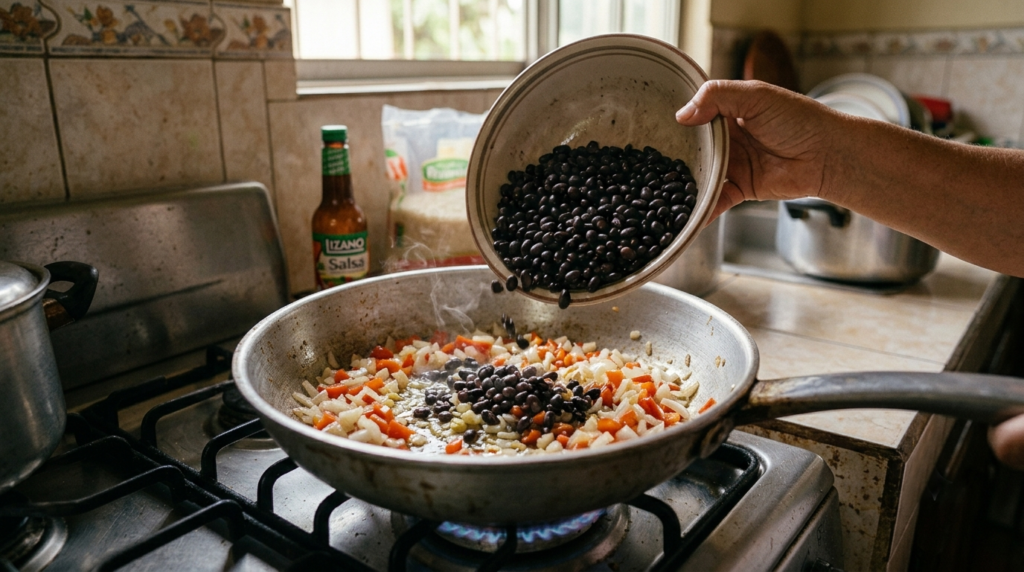
- Once the sofrito is ready, add the cooked beans with their broth to the skillet. The broth provides the color and moisture.
- Mix well and let it simmer gently for 2-3 minutes. This allows the flavors to meld.
- Add the cold, day-old rice.
Step 3: The Final Touch — Lizano Salsa and Cilantro
This is the step that defines the Costa Rican flavor. Lizano Salsa is a vegetable-based condiment, slightly sweet and spiced, and there is no substitute for it.
- With the rice and beans integrated, slightly increase the heat to medium-high.
- Generously add Lizano Salsa. Start with about 2 tablespoons and taste. It should have a uniform brown color and a distinct flavor.
- Stir constantly but gently to avoid breaking the rice grains, allowing the rice to absorb the liquid and “dry” a bit (about 3-5 minutes).
- Just before turning off the heat, mix in the fresh chopped cilantro. Stir one last time so the residual heat releases the cilantro’s aroma.
And that’s it! Your authentic Gallo Pinto is ready. Serve immediately, ideally with fried or scrambled eggs, natilla (sour cream), fresh blanco cheese, and fried ripe plantains.
Here is the final result, freshly cooked and steaming: