
There is something quietly distinctive about Sundays in Costa Rica. It’s not announced loudly, nor marked by strict routines, but it is felt in the slower pace of the streets, in the way conversations linger, and in the sense that the day belongs less to obligation and more to presence.
For many foreigners, the first Sunday here can feel unexpectedly calm. Shops may open later, neighborhoods seem quieter, and the usual weekday urgency softens into something almost unspoken. It’s not inactivity t’s intention. A different way of moving through time.
The day often begins gently. Morning light filters through open windows, and the aroma of fresh coffee fills the home. Breakfast is rarely rushed. It may be simple bread, fruit, perhaps eggs but it’s shared, not consumed on the go. There is time to sit, to talk, to ease into the day without pressure.
In many households, Sunday morning still carries a traditional undertone. Some families prepare for church, while others simply embrace the slower rhythm from home. Even for those who don’t follow religious routines, the influence remains: Sunday is a day to pause, to reconnect, to step slightly outside the demands of the week.
As the morning unfolds, small rituals take shape. A visit to the local bakery for fresh bread or pan dulce. A walk through the neighborhood. A quick stop at a nearby market. These aren’t tasks to check off a list they are part of the experience itself. Each interaction carries a sense of familiarity, even for those who are just beginning to understand the culture.
By midday, the heart of Sunday begins to reveal itself: food and family.
Lunch is not just a meal it is often the anchor of the day. Families gather, sometimes across generations, around dishes that feel both comforting and deeply rooted in tradition. Rice, beans, meats, fresh salads, and natural drinks come together in a way that feels abundant but unpretentious. The table becomes a space not only for eating, but for storytelling, laughter, and connection.
For foreigners, this moment can be one of the most striking. Time seems to expand. There is no rush to finish, no urgency to move on to the next activity. Conversations stretch naturally, moving from one topic to another without direction or deadline.
After lunch, the pace slows even further.
Afternoons often drift into rest. Some people take a nap, others sit outside, enjoying the air and the quiet. It’s common to see families gathering in living rooms, watching television, or simply spending time together without a specific purpose. The day doesn’t demand productivity it allows space.
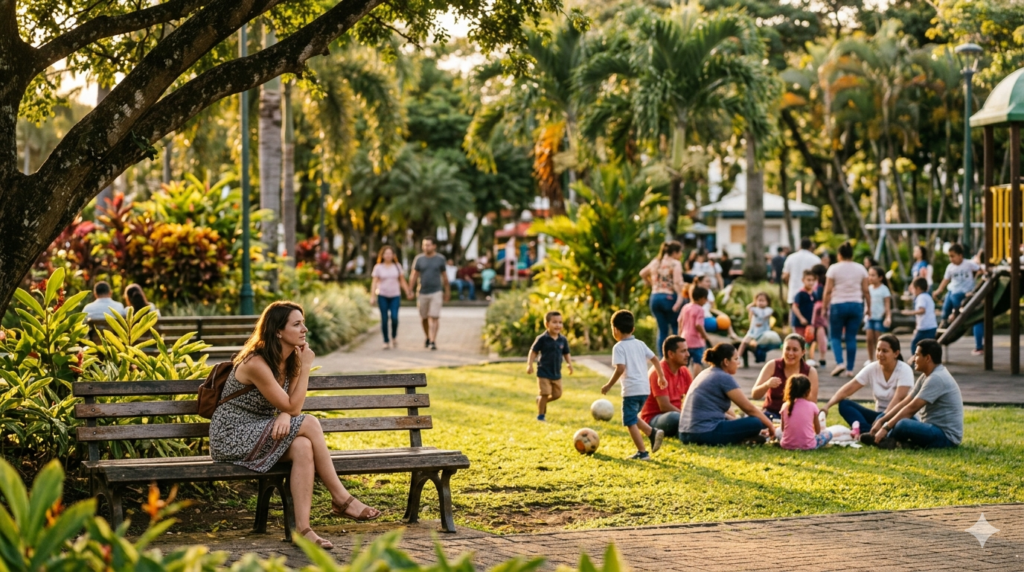
In many towns, public spaces come alive in a subtle, relaxed way. Parks fill with families, children play freely, couples walk side by side. There is a shared understanding that Sunday is meant to be lived differently. Even the energy of the streets reflects this less hurried, more open, more human.
For those used to tightly scheduled weekends, this can feel unfamiliar. There are fewer structured activities, fewer commitments, fewer expectations to “make the most” of the day in a productive sense. And yet, there is a richness that comes from this simplicity.
As the evening approaches, the day begins to wind down quietly. Dinner is usually lighter, conversations become softer, and there is a gentle transition toward the coming week. It’s not abrupt. It happens naturally, almost without notice.
What stands out most about a typical Sunday in Costa Rica is not any single activity, but the overall feeling. It is a day shaped by connection rather than obligation, by presence rather than urgency. It reflects a broader cultural mindset one that values time not as something to control, but as something to share.
For foreigners, adapting to this rhythm can take time. The instinct to plan, to optimize, to fill every hour doesn’t disappear overnight. But slowly, something shifts. The need to do gives way to the ability to simply be.
And in that shift, Sundays begin to feel different not just in Costa Rica, but anywhere.
Because once you experience a day without rush, without pressure, and without constant movement, you begin to understand that perhaps time was never meant to be so tightly held in the first place.