
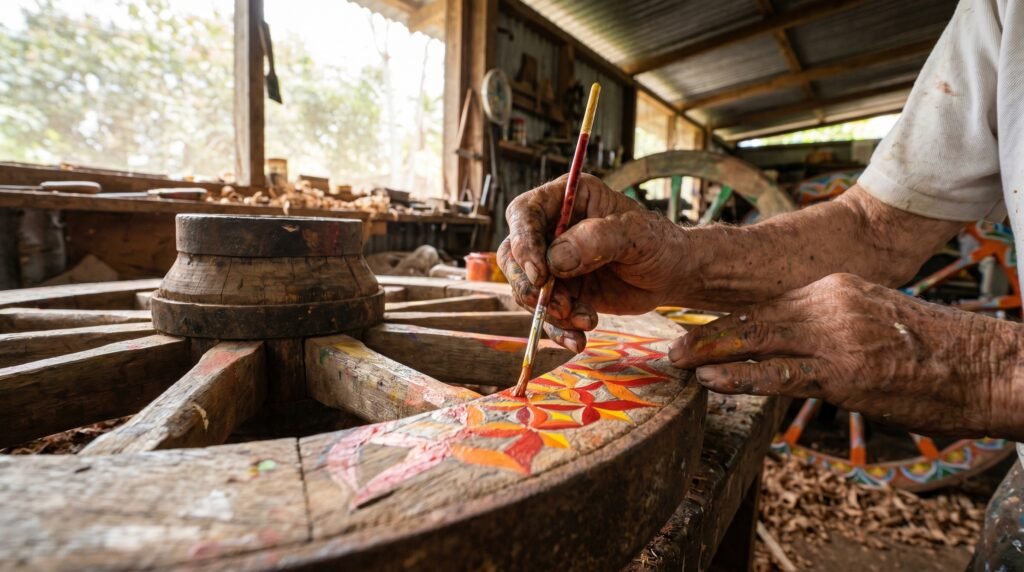
In a world increasingly dominated by mass-produced plastic and digital convenience, there is a profound, quiet resistance happening in the workshops of Costa Rican artisans. To the casual traveler, a hand-painted miniature oxcart is a charming souvenir. To a Tico, it is a vessel of national identity. Traditional Costa Rican crafts are not merely relics of the past; they are a living dialogue between our ancestors and our future. Understanding these crafts is essential to understanding the social fabric of a nation that values peace, labor, and nature above all else.
The Sarchi Oxcart: A Symphony on Wheels
The most recognizable symbol of Costa Rican culture is undoubtedly the Carreta, or oxcart. Designated as a Masterpiece of the Oral and Intangible Heritage of Humanity by UNESCO, the oxcart was originally a functional tool used to transport coffee from the Central Valley to the ports on the coast.
However, in the early 20th century, something beautiful happened. Farmers began painting their carts with vibrant, kaleidoscopic patterns known as colochos. No two carts were exactly alike; the designs often signaled the pride of the family and the specific region they hailed from. Today, the town of Sarchí remains the epicenter of this craft. Artisans here still use the same compass-and-brush techniques passed down through generations. These crafts matter because they transformed a mundane agricultural tool into a canvas of national pride, proving that even the hardest labor can be infused with art.
The Chorotega Pottery of Guaitil
Venturing into the Nicoya Peninsula, specifically the village of Guaitil, one encounters a tradition that predates the Spanish conquest by centuries. The Chorotega people were masters of ceramics, and their descendants continue to use the exact same raw materials: local clay, natural earth pigments (curiol), and stone polishers.
The process is grueling. The clay must be cured, the shapes thrown by hand, and the intricate motifs of jaguars, iguanas, and shamans etched with precision. What makes Chorotega pottery significant today is its sustainability and its role in cultural preservation. In a globalized economy, the artisans of Guaitil provide a blueprint for how indigenous communities can maintain their autonomy and heritage through specialized, eco-friendly craftsmanship.
The Mascaradas: The Face of the Community
If you find yourself in Barva de Heredia or Escazú during a patron saint festival, you will meet the Mascaradas. These are giant, oversized heads made of papier-mâché or fiberglass, depicting characters like La Giganta, El Diablo, and La Segua.
The craft of the mascarero is one of social cohesion. These masks are designed to be worn by locals who dance through the streets to the rhythmic “cimarrona” brass bands. Unlike the polished art found in galleries, masks are meant to be touched, bumped, and sweat in. They represent the “Tico” sense of humor a way to poke fun at authority and legends while bringing the entire neighborhood together. They matter because they are the heartbeat of our communal celebrations, ensuring that the “barrio” remains a place of shared joy.
Boruca Textile Weaving: Strings of History
In the southern mountains, the Boruca (or Brunka) indigenous group maintains a weaving tradition that is a masterclass in botany and patience. Using backstrap looms one of the oldest weaving methods in existence the women of Boruca create intricate fabrics dyed with natural ingredients like the murex mollusk, basil, and teak leaves.
While their “Diablitos” masks are famous, their textiles are the unsung heroes of their culture. Each thread represents a connection to the land. When you hold a Boruca weave, you are holding a physical manifestation of the Costa Rican forest. In an era of “fast fashion,” these textiles remind us of the value of slow, intentional creation and the sacredness of natural resources.
Why Preservation is a Social Necessity
Why do these crafts matter in 2026? It isn’t just about tourism revenue. It is about social resilience.
- Intergenerational Bonding: These crafts require an apprenticeship. When a grandfather teaches his grandson how to balance an oxcart wheel, he is transmitting values of patience, discipline, and respect for history.
- Economic Autonomy: Traditional crafts allow rural communities to thrive without depending on urban industrialization. It keeps the “local” in the local economy.
- Environmental Stewardship: Most Tico crafts rely on natural materials. To be an artisan is to be a protector of the trees, the clay pits, and the natural dyes.
The Future of the Handmade
The challenge for Costa Rican artisans today is competing with cheap imitations. However, there is a growing movement of “Cultural Tourism” where visitors seek out the workshop rather than the gift shop. By choosing authentic, handmade pieces, we aren’t just buying an object; we are funding the continuation of a story.
Costa Rica’s traditional crafts are the threads that keep our social fabric from unraveling. They remind us that we are a people of the earth, a people of color, and a people who find beauty in the work of our hands. Next time you see a painted wheel or a clay jar, look closer you’re looking at the heartbeat of a nation.