If you’ve ever tried to look up a word you heard in Costa Rica and found nothing not in a Spanish dictionary, not on Google Translate, not anywhere you weren’t imagining things. That word exists. It just doesn’t exist anywhere outside of here.
Costa Ricans have been quietly building their own language for generations. We took Spanish, yes, but then we bent it, shortened it, repurposed it, and occasionally invented words from thin air. Linguists call these words costarriqueñismos, expressions so uniquely ours that no other Spanish-speaking country uses them, recognizes them, or frankly, fully understands them. For visitors trying to follow a conversation, they can feel like hitting a wall. For those who take the time to learn them, they become something more like a key.
Here are the words Costa Ricans invented and what they actually mean.
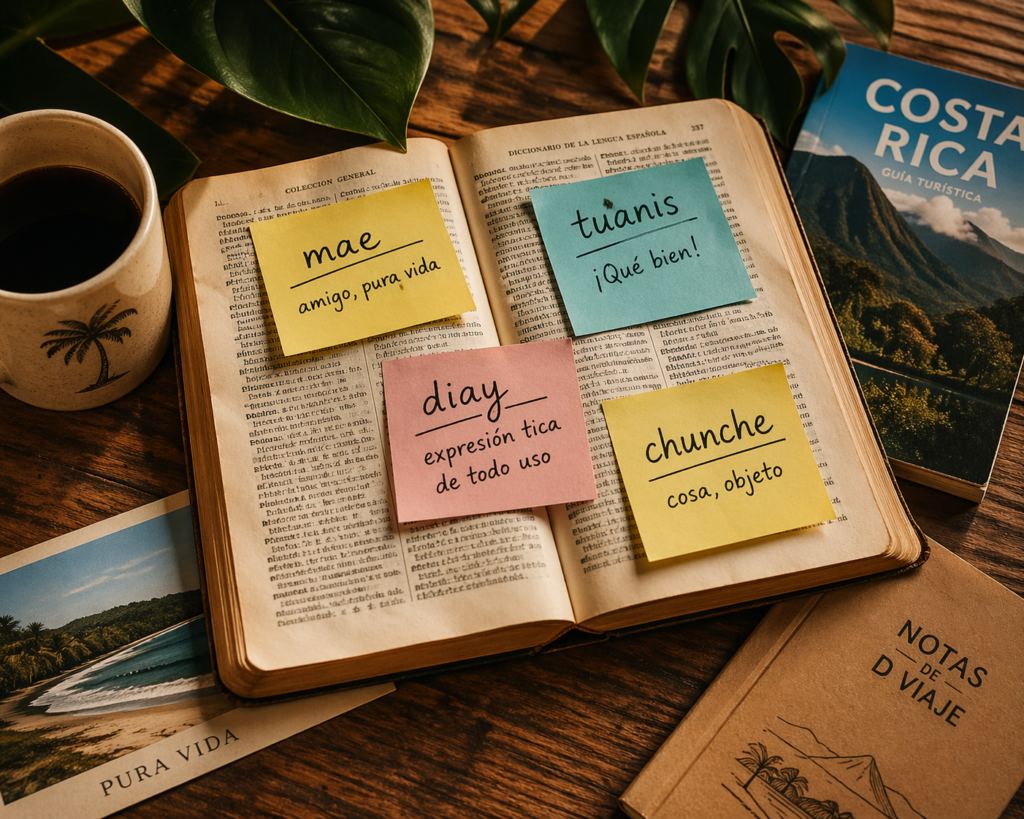
Mae
Every language has a word that does too much work. In English, it’s “like.” In tico Spanish, it’s mae. It means dude, man, buddy, friend, that guy, this person, and also nothing at all, it just fills space the way punctuation fills a sentence. You’ll hear it four times in a single sentence between friends, and each instance will feel slightly different. It comes from the older word maje, softened over time into something warmer and more versatile. Don’t use it with your taxi driver’s grandmother. Otherwise, mae, you’re fine.
Tuanis
Cool. Awesome. Great. No problem. Tuanis covers the entire positive spectrum with one word, and nobody is entirely sure where it came from. The most accepted theory traces it to English,”too nice”, absorbed and tico-fied over decades. Whatever its origin, it landed perfectly. Something is tuanis or it isn’t, and when a Costa Rican tells you that your idea, your outfit, or your pronunciation is tuanis, accept the compliment.
Diay
This one is impossible to translate and essential to understand. Diay functions as a filler, a sigh, an expression of mild surprise, a way of saying “well…” or “I mean…” or “what can you do.” Its tone does all the heavy lifting. A sharp diay can express frustration. A soft, drawn-out diay can mean you’ve just accepted something you can’t change. It appears in sentences the way seasoning appears in good cooking, you don’t always notice it, but you’d notice if it was gone.
Chunche
The most useful word in the tico vocabulary for anyone learning Spanish. A chunche is any object whose name you’ve forgotten, don’t know, or simply can’t be bothered to remember right now. “Pass me that chunche” is a complete and perfectly valid sentence here. It has no Spanish equivalent. It’s purely ours, and it has saved more conversations than any phrase book ever will.
Brete
In standard Spanish, brete describes a narrow passage, like a chute for cattle. In Costa Rica, it means work, your job, your labor, the place you spend your weekdays. Nobody knows exactly when or why the shift happened, but it stuck completely. “I can’t come, I have brete” is one of the most commonly heard sentences in the country, and it has absolutely nothing to do with livestock.
Goma
In Spanish, goma means glue. In Costa Rica, it means hangover. This linguistic leap is its own kind of poetry, the idea that the morning after too much guaro leaves you feeling stuck, heavy, and unable to move. Whatever the origin of the metaphor, every tico understands it immediately. “Estoy de goma” requires no further explanation and will instantly earn you sympathy, or at least a knowing smile.
Literally: “to the chile pepper.” Actually: “seriously,” “for real,” or “I mean it.” Al chile is used to confirm something true, to express disbelief, or to add weight to a statement. “Al chile, mae, that was the best casado I’ve ever had.” It’s one of those expressions that makes no logical sense and perfect cultural sense at the same time.
Al chile
Literally: “to the chile pepper.” Actually: “seriously,” “for real,” or “I mean it.” Al chile is used to confirm something true, to express disbelief, or to add weight to a statement. “Al chile, mae, that was the best casado I’ve ever had.” It’s one of those expressions that makes no logical sense and perfect cultural sense at the same time.
Mejenga
A pickup soccer game, informal, neighborhood-level, more about fun than competition. The word doesn’t exist in any other country. It doesn’t need to. Costa Ricans play mejengas the way other cultures have tea: regularly, socially, and with great seriousness about something that is technically casual.
Zarpe
The last drink of the night. The one you have after you already said you weren’t having any more. In other Spanish-speaking countries, there’s no single word for this specific moment. In Costa Rica, there is, and the fact that we needed one says something beautiful about the culture.
Language doesn’t just reflect a people it reveals them. Every word on this list is a small window into how ticos think, what they value, and how they move through the world: with warmth, humor, flexibility, and a cheerful willingness to invent whatever they need.
You won’t find these words in any dictionary. But spend a week in Costa Rica, and you’ll find them everywhere.
That’s the thing about costarriqueñismos. They don’t need a dictionary. They have a whole country.