
Not the postcard weekend of zip lines and beach hotels. The real one, lived by millions of ordinary Costa Ricans between Friday evening and Sunday night, built around the feria, the football match, and the family table.
The Costa Rican weekend does not announce itself with fireworks. It begins quietly, usually on Friday afternoon, with a slight loosening in the rhythm of the week, a sense that the obligations of Monday through Friday have finally released their grip, even if only temporarily. What happens next is remarkably consistent across income levels, regions, and generations, even as the specific activities shift slightly from family to family.
Foreigners who imagine the Costa Rican weekend often picture something closer to a tourism brochure, a hike through a rainforest, a surf lesson, a hot spring soak under a volcano. Those things exist and Costa Ricans do enjoy them, but they are occasional indulgences, not the default pattern. The default pattern is considerably more domestic, more social, and more repetitive in the best sense of that word, built around rituals that have remained largely unchanged for generations because they continue to work.
I am Costa Rican, I am thirty five years old, and my own weekends follow this pattern almost without variation, the way most weekends in most Costa Rican households do. This article walks through what an ordinary weekend actually looks like here, from Friday evening through Sunday night, with the specific texture that no travel guide bothers to include.
None of this is exotic. That is precisely the point. The Costa Rican weekend reveals more about the culture’s actual values than almost anything else in daily life, because it shows what people choose to do when no one is requiring anything of them.
By Friday at five in the afternoon, something shifts in the collective mood of a Costa Rican office, a school, a neighborhood. Conversations slow down. People start talking about what they are cooking for the weekend, who is coming to lunch on Sunday, whether the football match on Saturday will be worth watching live or recorded. The transition from workweek to weekend here is not marked by elaborate plans or expensive outings. It is marked by a return to the rituals that have structured Costa Rican leisure for generations, rituals that are remarkably consistent across the country regardless of income level or region.
Friday night, the soft landing
Friday evening in Costa Rica rarely involves dramatic celebration. Most families ease into the weekend rather than launching into it, with a dinner that is slightly more relaxed than a weekday meal, sometimes takeout from the neighborhood chicken rotisserie, sometimes a homemade dish that took longer to prepare than a Tuesday would allow. Many households watch television together, often a telenovela or the Friday night football broadcast, and conversation tends to be lighter, less rushed, oriented toward the two days ahead rather than the five just completed. Younger adults without children often use Friday night for social plans, dinner with friends, a bar in a neighborhood like Barrio Escalante in San José, though this segment of the population is smaller than international stereotypes about Latin American nightlife might suggest.
Saturday morning, the feria
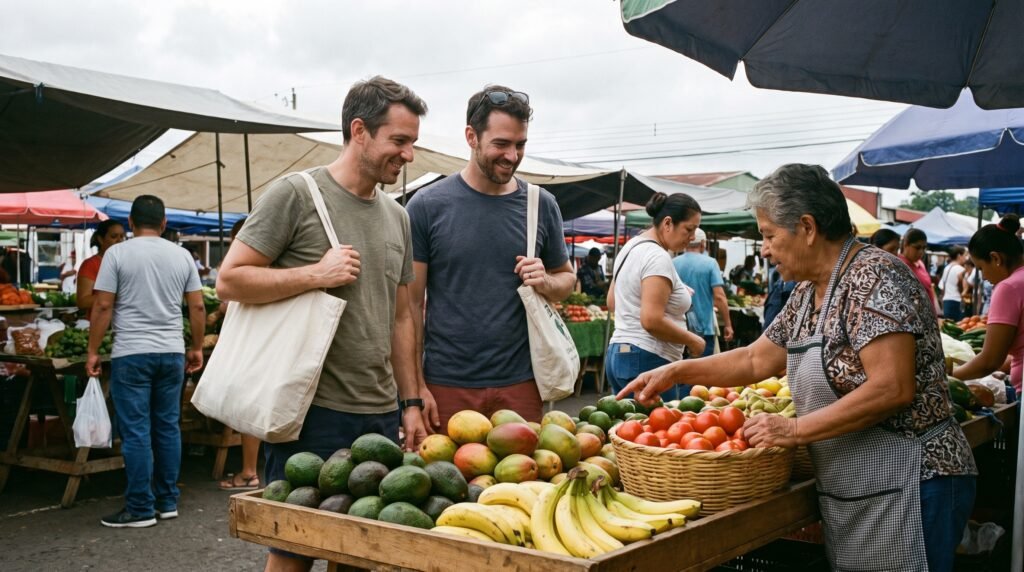
If there is one ritual that defines the Costa Rican Saturday more than any other, it is the feria, the outdoor farmers market that operates in nearly every city and town across the country, typically from early morning until early afternoon. Families arrive with reusable bags and a mental list, moving from stall to stall buying produce that is fresher and cheaper than supermarket equivalents, while greeting vendors they have bought from for years and running into neighbors they have not seen since the previous Saturday. The feria is not simply a shopping errand. It is a weekly social institution, one of the few remaining spaces where an entire community of different ages and income levels still moves through the same physical space at the same time, exchanging greetings and small talk that have nothing to do with commerce.
“The feria is not simply a shopping errand. It is a weekly social institution, one of the few remaining spaces where an entire community still moves through the same physical space, exchanging greetings that have nothing to do with commerce.”
Saturday afternoon, soccer and household rhythms
Saturday afternoon in Costa Rica belongs, to a significant degree, to football. Liga Deportiva Alajuelense and Deportivo Saprissa, the country’s two most storied clubs, draw fierce loyalty that often follows family lines rather than geography, and a Saturday match between them can reorganize an entire household’s afternoon around the television. For those without a match to watch, Saturday afternoon tends to be devoted to household tasks that the workweek did not allow, washing the car, doing laundry, tackling a home repair, running errands that require the kind of unhurried time that a weekday lunch break does not provide. None of this is glamorous, and none of it needs to be. The Saturday afternoon in Costa Rica is, for most households, a quiet exhale rather than an event.
Saturday night, modest and social
Saturday night carries slightly more social weight than Friday, particularly for younger adults and couples without small children. A dinner out, a gathering at a friend’s house, a casual party with music and beer in someone’s backyard, these are common but rarely elaborate. Families with young children often stay home, sometimes hosting a small family gathering, sometimes simply enjoying an evening with fewer obligations than a typical weeknight. The Costa Rican Saturday night, even at its most social, tends to retain a domestic, unpretentious quality, less about spectacle and more about the simple pleasure of unstructured time with people you like.
Sunday, the day that belongs to the family
If Saturday is flexible, Sunday is not. Sunday in Costa Rica is, for the overwhelming majority of families, organized around a single, non negotiable event, lunch at the family home, usually the home of a parent or grandparent, usually beginning sometime around noon and stretching well into the afternoon. This is the ritual described throughout this site’s coverage of Costa Rican family life, and it deserves repeating here because it is the single most defining feature of how Costa Ricans actually spend their weekends. Extended family arrives gradually, food is prepared in quantities that always exceed what seems necessary and always disappears anyway, and the afternoon unfolds without a clear endpoint, conversation extending long after the plates have been cleared.
Sunday afternoon, after lunch, often involves a collective lull, some family members napping, others watching television, children playing in whatever outdoor space is available, older relatives continuing conversations that began at the table. Many families use Sunday afternoon for a visit to a nearby park, a short drive to see other relatives, or simply more time at the same gathering that started at lunch. Evangelical and Catholic families may attend church earlier in the day, with the lunch gathering following rather than competing with religious observance. By Sunday evening, the mood shifts again, a quieter, slightly heavier tone settling in as the household begins, almost imperceptibly, to prepare for Monday.
What the weekend reveals about the culture
Looking at the Costa Rican weekend as a whole, certain patterns become impossible to miss. Almost none of it involves spending significant money. Almost all of it involves being physically present with other people, family, neighbors, vendors at the feria, fellow fans at a football match. The Costa Rican weekend is not organized around novelty or achievement. It is organized around repetition, connection, and a deliberate, weekly renewal of the relationships that matter most.
The Costa Rican weekend, stripped of any tourism marketing and observed simply as it actually unfolds, tells you more about this culture’s real priorities than almost any survey could. Given two full days with no obligations, most Costa Ricans choose the feria over a mall, the family table over a restaurant, the Sunday lunch over almost any alternative available to them. That choice, repeated every single week by millions of people, is itself the clearest possible statement of what this culture has decided actually matters.