
There is a moment every foreigner experiences in Costa Rica when money stops being just money.
It usually happens at a small counter a pulpería, a roadside fruit stand, or a quiet café when you reach into your wallet, pull out a large bill, and immediately feel that something isn’t quite right. The pause is subtle, but noticeable. The exchange becomes slower. More delicate. More… human.
Because in Costa Rica, cash is not just transactional. It’s cultural.
To understand how money works here is to understand a deeper layer of daily life one shaped by courtesy, awareness, and a quiet sense of mutual respect.
More Than Money: Bills as Living Symbols
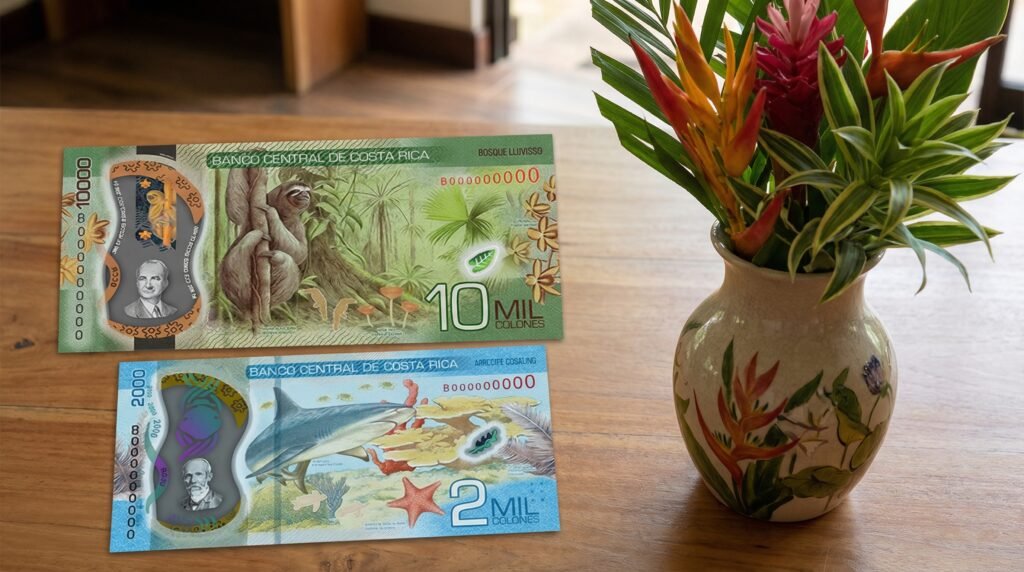
At first glance, Costa Rican colones stand out for their vibrant colors. But the more you look at them, the more they begin to feel like something else entirely -almost like small pieces of art.
Unlike traditional paper currency, Costa Rican bills are made of polymer, giving them a smooth, almost plastic-like texture. They are durable, flexible, and visually striking. But what truly captures attention is what they represent.
Each bill carries the presence of Costa Rica’s natural world.
The 2,000 colón note, for example, features a bull shark an animal both powerful and mysterious, often associated with the country’s rich marine life. The 5,000 colón bill showcases the white-faced capuchin monkey, a familiar figure in Costa Rica’s forests and a symbol of its biodiversity.
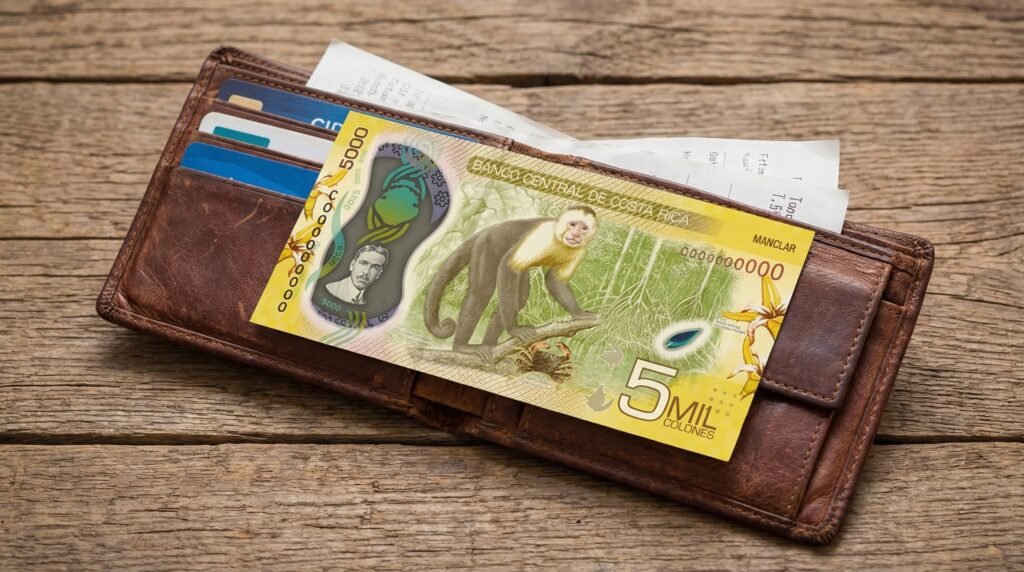
For foreigners, this creates an unexpected connection. Even in urban settings, even in the most routine transactions, nature is still present woven into everyday life in a way that feels intentional.
The Culture of “Menudo”
One of the first unspoken rules foreigners encounter is the importance of menudo small change.
In many countries, paying with large bills is normal. In Costa Rica, especially in small businesses, it can feel disruptive. Handing over a 20,000 colón bill at a local shop for a small purchase often creates a moment of hesitation.
Not because it’s unacceptable, but because it complicates the exchange.
Small businesses, street vendors, and rural shops don’t always carry large amounts of change. Having menudo is seen as a sign of awareness an understanding of how things work locally. It’s a small gesture, but it carries weight.
Over time, foreigners begin to adjust. They learn to break larger bills when possible. They start to carry smaller denominations. And without realizing it, they begin to participate more smoothly in the rhythm of daily life.
Speaking the Language of Money
Beyond the physical bills, there is also a linguistic layer that often goes unnoticed at first.
Costa Ricans rarely refer to money in purely numerical terms. Instead, they use informal expressions that reflect familiarity and cultural identity.
A 1,000 colón bill is commonly called “un rojo” a reference to its red color. Other colors and references naturally enter conversation, creating a kind of shared shorthand.
For foreigners, learning this vocabulary can be surprisingly powerful. It transforms interactions. It signals effort, respect, and a willingness to engage beyond the surface.
It’s not just about understanding prices it’s about understanding context.
The Subtle Etiquette of Service and Tipping
One of the most common areas of confusion for foreigners arises when dining out.
In Costa Rica, restaurant bills typically include a 10% service charge by law, along with a 13% sales tax (IVA). This means that, unlike in countries where tipping is expected on top of the bill, the service is already accounted for.
For newcomers, this can feel uncertain. Should you tip more? Is it expected?
The answer is nuanced.
While additional tipping is not required, leaving a small extra amount for exceptional service is always appreciated. But there is no pressure, no strict expectation. The system is designed to be fair and transparent.
Understanding this removes a layer of social anxiety. It allows foreigners to engage with confidence, without overthinking every transaction.
Trust in Everyday Transactions
Perhaps one of the most striking aspects of handling cash in Costa Rica is the underlying sense of trust.
In more rural areas, or along quiet roads, it’s not uncommon to encounter simple fruit stands sometimes unattended, sometimes operating with minimal structure. Transactions happen with a level of honesty that can feel unfamiliar to those coming from more transactional environments.
You take what you need. You pay what is fair. The exchange is based less on enforcement and more on shared understanding.
Even in small shops, interactions often feel personal rather than mechanical. There is eye contact. There is conversation. There is a sense that the transaction is not just about money, but about connection.
Beyond Currency: A Reflection of Values
For foreigners, adapting to Costa Rican cash etiquette is not just about learning how to pay it’s about learning how to participate.
It requires slowing down. Paying attention. Being mindful of small details that might otherwise go unnoticed.
Over time, something shifts.
You begin to carry smaller bills without thinking. You recognize the colors instantly. You understand the rhythm of exchanges. And perhaps most importantly, you start to see money not as something purely functional, but as something relational.
Because in Costa Rica, even something as simple as paying in cash reflects a broader philosophy one that values ease, respect, and human interaction.
It is, in many ways, an extension of Pura Vida.
Not rushed. Not rigid. But intentional.
And once you understand that, even the smallest transaction begins to feel different.