
There is a particular kind of social failure that happens in Costa Rica that is almost impossible to detect in real time. Nobody flinches. Nobody corrects you. The conversation continues exactly as before warm, pleasant, apparently unaffected. And yet something has shifted. You said the wrong thing, or did the wrong thing, or skipped something you were supposed to do, and the room registered it without showing you that it did. This is one of the great social challenges of interacting with Ticos: the feedback loop is nearly invisible. We are too polite to make you uncomfortable in the moment. We will simply file the information away.
I’ve been watching this dynamic play out between Costa Ricans and foreigners my whole adult life at work, in my neighborhood, at family gatherings where someone brought a foreign friend. And I’ve noticed that the mistakes foreigners make are rarely dramatic. Nobody is being rude on purpose. The missteps are almost always small, structural, cultural the kind of thing that nobody thinks to explain because, from our side, it seems too obvious to mention. Which is exactly why I’m going to mention it.
What follows is not a list of rules. It is a guide to the unspoken logic underneath the rules, because if you understand why something matters here, you won’t need me to remind you of it.
DO: Greet every single person in the room.
When you enter a space a home, a small office, a family gathering, a neighborhood soda where the same three men are always sitting, greet everyone present. Not a general wave at the room. Each person, individually.
This is not optional in Costa Rican social culture. It is a foundational act of acknowledgment, and skipping it even accidentally, even because you were distracted or in a hurry registers as dismissiveness. The grandmother in the corner who you walked past without a buenos días will remember. The coworker you didn’t make eye contact with during the morning round will notice. We don’t require elaborate greetings. A simple “buenos”, “buenas” with eye contact is enough. But that contact must happen, individually, with each person. The same logic applies in reverse when you leave: you say goodbye to each person, not to the room.
Foreigners from cultures where a general nod suffices or where individual greetings feel socially excessive, consistently underestimate how much this matters. It is not ceremony. It is the basic social grammar of saying: I see you, you are not invisible to me. In a culture that runs on relational warmth, skipping this step is the equivalent of starting a sentence in the middle.
DON’T: Show up empty-handed to someone’s home.
If someone invites you to their home for dinner, for a Sunday lunch, for any gathering that involves food arrive with something. A cake from the bakery, a bottle of wine, a bag of fresh fruit. The value matters less than the gesture.
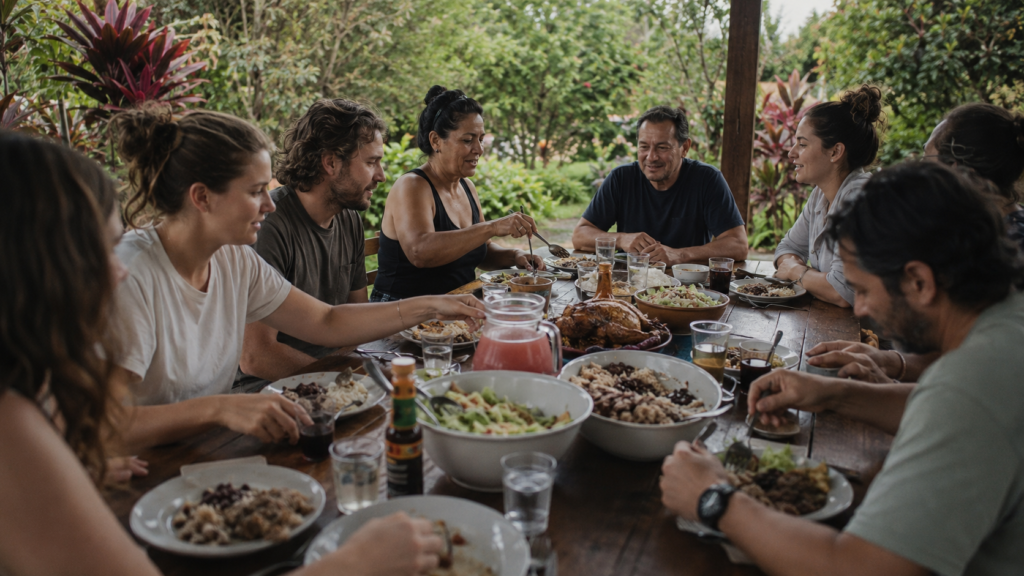
Costa Rican hospitality is generous and often elaborate. A family that invites you for lunch has likely been cooking since the morning. The table will be full. The portions will be large. To arrive with nothing communicates, at a level that most people won’t say out loud but will feel, that you took the invitation for granted. That you assumed the effort would be made for you without any gesture of reciprocity on your part.
The gift does not need to be expensive or thoughtful in a sophisticated way. A pan de yemas from a local bakery, a bunch of heliconia from the market, a box of bombones, these cost almost nothing and communicate everything. What they say is: I thought about this before I came. That thought is what matters.
DO: Accept food when it’s offered. At least once.
When a Costa Rican offers you food or coffee in their home, the correct answer at least the first time is yes. Even if you just ate. Even if you don’t particularly want coffee. Accept it, take a few sips, and express genuine appreciation.
Offering food is an act of care in this culture. It is one of the primary ways warmth is expressed and hospitality is enacted. When someone puts a cup of coffee in front of you, they are not simply providing a beverage. They are performing an act of welcome, of inclusion, of I want you to feel at home here. Refusing that offer, especially briskly, especially with a “no thanks, I’m fine” deflects the act of care along with the coffee. It creates a small awkwardness that the host will smooth over graciously and remember quietly.
If you have dietary restrictions or simply cannot eat something, a gentle explanation with visible appreciation for the offer will always land well. What you want to avoid is the reflexive, distracted refusal the kind that communicates that you didn’t register that something was being offered to you at all.
DON’T: Rush the conversation to get to the point.
Costa Rican social and professional interaction begins with relationship, not agenda. Before any business is discussed, any request is made, or any practical matter is addressed, there is a period of genuine human exchange. Skip it at your peril.
This catches people off guard in professional settings especially. A foreigner arrives at a meeting with a clear agenda and a limited time window and wants to get straight to the point. The Costa Rican counterpart begins by asking about the family, commenting on the weather, making a joke about traffic. The foreigner interprets this as small talk to be dispatched quickly. The Costa Rican is reading the foreigner’s willingness to be a person before being a transaction.
“Before any business is discussed or any request is made, there is a period of genuine human exchange. Skip it at your peril.”
If you cut that process short, if you redirect to the agenda before the relationship has been acknowledged, you have communicated something about your priorities that will quietly color the rest of the interaction. In Costa Rica, how you treat the preamble to a conversation is not irrelevant to the conversation itself. It is part of it. Budget the time. Ask about the family. Mean it, or at least perform meaning it convincingly. The work goes better afterward.
DO: Learn a few words of Spanish. Use them imperfectly and with+out apology.
You do not need to speak Spanish well to earn respect in Costa Rica. You need to try. The attempt earnest, imperfect, slightly embarrassing is the thing that matters. It signals that you came here to engage with the place, not just to occupy it.
Costa Ricans are, as a rule, extraordinarily patient with foreigners attempting Spanish. A mispronounced “con mucho gusto” will be received with warmth, not correction. A mangled attempt at “mae, ¿dónde queda la soda?” will almost certainly produce directions, a laugh, and a brief moment of genuine connection. The willingness to be vulnerable in a language you don’t control is, here, a form of respect. It says: your language is worth my effort. That lands.
What does not land and this is worth being direct about is the assumption that English is a right rather than a convenience. Most service workers in tourist areas speak enough English to help you. Many do not. Approaching a transaction with the implicit expectation that the other person should accommodate your language, without any acknowledgment of the gap, reads as the kind of entitlement that quietly confirms every negative stereotype about North American tourists. Try the Spanish first. Always.
DON’T: Make loud complaints in public.
If something goes wrong, the service is slow, the order is incorrect, the room is not what you expected address it quietly, directly, and without performance. A calm and private conversation will resolve almost any problem in Costa Rica. A public display of frustration will resolve nothing and cost you significantly.
Costa Ricans have a deep aversion to public confrontation. Raised voices, aggressive body language, and theatrical expressions of displeasure do not accelerate resolution here, they trigger a kind of social shutdown in which the person on the receiving end becomes less able, not more, to help you. The staff member who was about to find a solution quietly retreats. The manager who was going to offer a discount reconsiders. The entire social machinery that runs on goodwill and mutual courtesy seizes up because you have violated the terms under which it operates.
I have watched this happen in restaurants, in hotels, at car rental counters, in government offices. The foreigners who get things resolved efficiently in Costa Rica are almost always the ones who maintain a pleasant, unhurried, apologetic tone even when they have every right to be frustrated. “I think there may have been a misunderstanding” opens more doors here than “this is completely unacceptable.” This is not weakness. It is code-switching. And it works.
DO: Take off your shoes when entering certain homes.
Not universal, but common enough that you should watch for the cue. If you arrive at a home and notice shoes lined up near the entrance, or if your host removes their shoes upon entering, follow suit without being asked. And do it naturally, as if it never occurred to you to do otherwise.
This is a small thing that signals a large thing: that you pay attention. That you notice how people live in their own spaces and adapt yourself to them rather than requiring them to adapt to you. In a culture where hospitality is taken seriously and homes are treated as intimate, carefully maintained spaces, often by women who cleaned that floor this morning tracking in street dirt without a second thought is a minor act of obliviousness that registers as disrespect, even if no one says so.
DON’T: Compare Costa Rica unfavorably to where you came from.
Whatever frustrations you encounter the roads, the bureaucracy, the internet speed, the inconsistent hot water keep the comparative commentary to yourself, or at minimum to other foreigners. Expressing it to Costa Ricans, even casually, even framed as light humor, rarely lands the way you intend.
Costa Ricans are proud of their country in a way that is genuine and sometimes fierce, even among people who have their own complaints about how things work here. We are allowed to criticize our roads. You are not or at least, not yet. Not until the relationship has enough history and trust to hold that kind of candor. Arriving and immediately cataloguing what is worse here than at home communicates that you came with a measuring stick rather than an open mind. It is the tourist version of a guest who spends the whole dinner talking about how their own mother’s cooking is better.
There is a version of this that is acceptable: genuine curiosity. “Why does this work this way?” asked with honest interest is a different thing entirely from “this would never be allowed back home” offered as mild condemnation. Costa Ricans will happily discuss the contradictions and frustrations of their own country with you once they believe you love the place despite them. Until then, hold the comparisons.
The etiquette that lives underneath all the others
If there is a single principle that organizes all of the above, it is this: Costa Rican social life runs on the currency of mutual dignity. Every rule here, the individual greetings, the gift at the door, the accepted coffee, the patient small talk, the quiet complaint is an expression of the same underlying value. We treat each other as people who deserve to be seen, acknowledged, and handled with care. Not because we are saints. Because that is the social contract we have all agreed to, and breaking it even inadvertently, even with the best intentions disrupts something that we all depend on.
The good news is that this contract is extraordinarily forgiving of foreigners who are genuinely trying. Ticos are not looking for perfection. They are looking for the evidence that you are paying attention that you came here with enough respect for the place and the people in it to notice how things work and to try, however imperfectly, to honor that. Make that effort visible, and most doors in Costa Rica will open for you far more easily than any guidebook would suggest.
Pura vida is not just something we say. At its best, it is the feeling in the room when everyone is treating each other well. That feeling is available to you too. You just have to earn it the way everyone else does one small, attentive gesture at a time.