
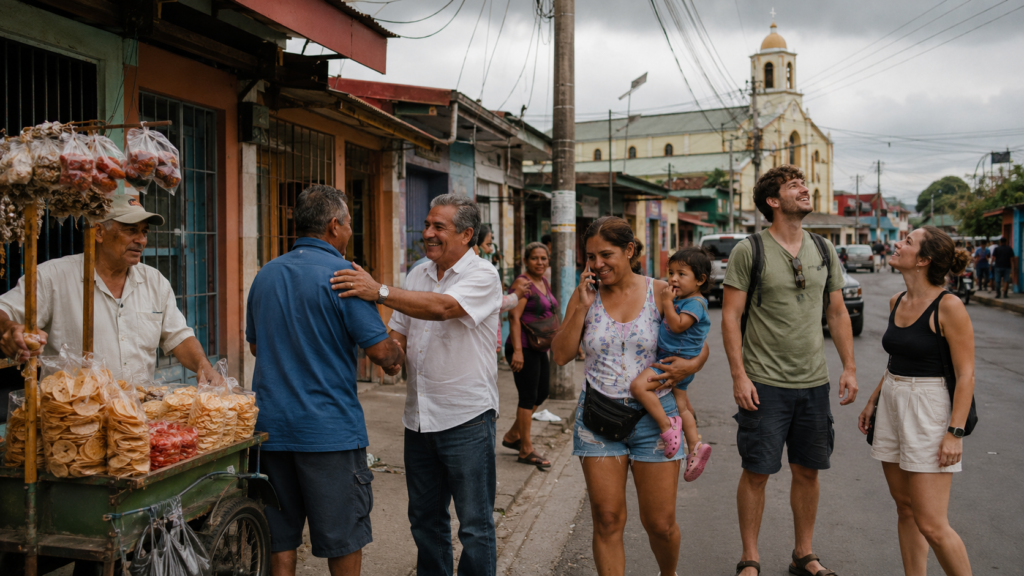
Every country has an operating system an invisible set of social rules, emotional reflexes, and cultural assumptions that runs quietly beneath every interaction. Most tourists never learn it. They move through a country reading the surface the food, the scenery, the friendliness of people without ever understanding the logic underneath. Costa Rica is particularly good at hiding its operating system, because the surface is so warm and so welcoming that most visitors assume there is nothing more to understand. There is. And once you understand it, everything here makes a different kind of sense.
I grew up in Heredia. I have watched tourists come and go my entire life, and I have noticed that the ones who leave genuinely changed by this place as opposed to merely satisfied with it are almost always the ones who picked up on something beyond the scenery. They learned a word or two of Spanish and used it badly and were rewarded with disproportionate warmth. They sat at a soda and let the meal take as long as it took. They greeted the security guard at the entrance of the supermarket and were greeted back like an old friend. Small things. But in Costa Rica, the small things are the culture. Here is how to find them.
On greetings and presence
Say hello to everyone, every time, individually.
When you enter a space a small shop, a home, a waiting room, a restaurant with only four tables greet every person present. Not a wave at the room. Each person, with eye contact. “Buenos días,” “buenas tardes,” or simply “buenas” works for any time of day and any level of formality. When you leave, do the same in reverse. This is not ceremonial politeness. It is the foundational act of social acknowledgment in Costa Rican culture the way you communicate that every person in the room exists and matters. Foreigners who skip it are not considered rude exactly, but they are noticed, and not favorably.
The cheek kiss is a greeting
Women typically greet each other and men they know with a single kiss on the right cheek or rather, a cheek-to-cheek touch with a kiss sound. Men usually greet each other with a handshake, sometimes accompanied by a shoulder grip or a brief hug between close friends. If you are a woman and a Costa Rican man you’ve just met leans in for the cheek greeting, this is completely standard lean in, touch cheeks, move on. If you are a man greeting a woman you don’t know well, let her initiate. When in doubt, a warm handshake with genuine eye contact will never be wrong for anyone.
Slow down before you speak.
Costa Rican conversation has a rhythm that is warmer and more meandering than what most Northern Europeans and North Americans are used to. Before you make a request, ask a question, or get to any practical point, there is an opening exchange a brief acknowledgment of the other person as a human being rather than a means to an end. Ask how they are and wait for the answer. Comment on something in the environment. Let the conversation find its footing before you direct it. This takes thirty seconds. It costs you nothing. It changes the entire quality of what follows.
Learn the difference between “ahorita,” “ahora,” and “ya.”
These three words represent three very different relationships with immediacy, and confusing them will cost you hours of unnecessary frustration. “Ya” means now actually now, right this moment. “Ahora” means soon within a reasonable timeframe, probably within the hour. “Ahorita” the diminutive means at some point in the near future that I am not prepared to specify, which in practice can range from ten minutes to never. When a plumber says he will arrive “ahorita,” build your afternoon around something else. When a waiter says “ya le traigo”, “I’ll bring it right away” your food is genuinely on its way. The distinction is real, and once you internalize it, the country’s relationship with time becomes considerably less mysterious.
Plans are flexible. Accept this gracefully
Costa Rican social plans operate on a spectrum of commitment that differs significantly from what most Northern cultures would consider confirmed. An invitation to “come by sometime” is genuine warmth, not a firm date. A plan made for Saturday may shift to Sunday without formal renegotiation. An event scheduled for seven will begin somewhere between seven-thirty and eight-fifteen. This is not disorganization it is a cultural prioritization of social ease over logistical precision. Arriving exactly on time to a Costa Rican dinner party will find you helping the host finish cooking. Arriving thirty minutes after the stated time will find you perfectly synchronized with everyone else. Relax into it. The evening will be better for it.
On food, homes, and hospitality
Accept the coffee. Drink the coffee. Appreciate the coffee.
Coffee in a Costa Rican home is not a beverage. It is a social gesture an act of welcome, of inclusion, of I want you to feel comfortable here. When your host offers you coffee, the culturally fluent answer is yes, even if you just had three cups, even if it is three in the afternoon, even if you are running late. Take the cup. Wrap both hands around it if it is a small ceramic one. Sip it. Say something genuine about it, Costa Rican coffee is excellent and deserves the compliment. Refusing a coffee offer briskly and without warmth deflects an act of care along with the caffeine, and your host will feel it even if they say nothing.
Bring something when you go to someone’s home.
A small gift when visiting someone’s home a bakery item, fresh fruit, a bottle of something is not obligatory, but it is noticed and appreciated in a way that exceeds its monetary value. What it communicates is that you thought about the visit before arriving, that you registered the effort being made on your behalf, and that you came with something to contribute rather than only to receive. The gift does not need to be elaborate. A pan dulce from the nearest bakery, a bag of fresh mangoes from a roadside stand, a local candy these cost almost nothing and carry significant social weight. The empty-handed guest is not judged harshly, but the guest who brings something is remembered warmly.
Eat what is put in front of you, and eat it with visible appreciation.
Costa Rican home cooking is an act of love, often hours in the making, always deeply personal. Gallo pinto, arroz con pollo, olla de carne, sopa negra; these dishes carry family memory and regional pride. When someone cooks for you, the culturally correct response is to eat with genuine attention and to say something specific about what you are tasting. Not “this is good”, but “this rice is different from anything I’ve had, what did you put in it?” or “the beans have something I can’t identify, is that culantro?” Specific appreciation shows that you were actually present to the food. That matters enormously to the person who made it.
On language and communication
Attempt Spanish. Fail loudly. Be rewarded for it.
Costa Ricans are among the most patient and generous recipients of broken Spanish in the world. A mispronounced “con mucho gusto,” a mangled “¿dónde está el baño?”, a hopelessly conjugated request for directions all of these will be met with warmth, patience, gentle correction if you want it, and the unmistakable sense that you have just risen several notches in the estimation of the person you are speaking with. The attempt communicates respect: your language is worth my effort. In a country that has absorbed enormous amounts of English-expectant tourism, that gesture still lands every single time.
Understand that “no problem” often means there is a problem.
Costa Ricans avoid direct confrontation and negative responses with a fluency that can be genuinely confusing. A “no problem” delivered with a slightly tighter smile than usual may mean there is a problem. A “sure, we can do that” with no follow-up questions may mean it will not be done. A “let me check on that” that leads to a subject change may mean the answer is no. This is not dishonesty, it is a deeply ingrained social reflex toward harmony over friction. Learning to read the register beneath the words the slight hesitation, the vague qualifier, the overly quick agreement. will save you a great deal of misplaced confidence in arrangements that were never quite confirmed.
| Phrase | Literal meaning | What it usually means |
|---|---|---|
| Ahorita | Right now | At some unspecified point soon or not |
| Vamos a ver | We’ll see | Probably no, but said kindly |
| Tal vez | Maybe | Most likely no |
| Con mucho gusto | With pleasure | You’re welcome used universally |
| Que Dios le bendiga | God bless you | A warm, sincere farewell not religious performance |
| Está ocupado | It’s busy / He’s busy | Not available right now don’t push |
| Pura vida | Pure life | Hello / goodbye / you’re welcome / no worries / great / fine |
| Mae | Dude / man | General term of address between peers, warm, informal |
| Diay | No direct translation | Filler word expressing mild surprise, resignation, or emphasis |
| No se preocupe | Don’t worry | Let’s move on from this topic gracefully |
On respect and presence
Ask before you photograph people.
This should not need to be said, but it does. A Costa Rican woman selling tortillas in a market, an elder sitting outside his house, a group of children playing in a neighborhood street, these are not subjects in your travel documentary. They are people with dignity and privacy, and photographing them without acknowledgment reduces them to props in your story. In most cases, if you lower your camera, make eye contact, smile, and gesture toward the camera with a questioning look, the answer will be yes and will come with a smile. That interaction that small negotiation of consent, is itself a meaningful cultural exchange, and the photograph you take after it will be infinitely better than anything taken from a distance.
Religion is present, respected, and not for debate.
Costa Rica is a majority Catholic country with a growing evangelical Protestant population and a deep cultural relationship with faith that spans across both. Religious imagery is everywhere in homes, in buses, on taxi dashboards, in the phrases people use in ordinary conversation. “Que Dios le bendiga”, “God bless you”, is a standard farewell that carries genuine warmth without being a doctrinal statement. “Si Dios quiere”, “God willing” accompanies plans and promises as a natural qualifier. Engaging with this respectfully means neither mocking it nor feeling obligated to reciprocate it. Simply receive it for what it is: an expression of the values that organize many people’s lives here, and a window into a culture where faith and daily life are not separate compartments.
Tipping is appreciated, not expected but do it anyway.
Costa Rica adds a ten percent service charge to most restaurant bills by law, so tipping on top of that is not obligatory the way it is in the United States. However, it is always appreciated, particularly in smaller establishments where the margin between a good night and a difficult one can be narrow. For guides, wildlife guides, cultural guides, community tour guides, tipping is important and should be generous. These are skilled professionals whose income depends heavily on what visitors choose to leave. A good guide in Costa Rica will give you access to a version of this country that is not available anywhere else. Pay for that access in a way that reflects its value.
The natural environment is not a backdrop. Treat it accordingly.
Costa Rica’s conservation ethic is genuine and widely felt, not just as a government policy but as a cultural value, particularly among the communities that live adjacent to forests, rivers, and coastlines. Littering in natural spaces, touching wildlife, picking plants in national parks, and feeding animals are not merely rule infractions here. They are the kind of behavior that locals register as a fundamental disrespect for a place they have worked hard to protect. The country that reversed dramatic deforestation and rebuilt its forest cover did so because people cared deeply enough to make it happen. Visitors who share that care who carry their trash out, who keep distance from animals, who follow guide instructions without arguing are participating in something real. Those who don’t are taking something they haven’t earned.
The single most culturally intelligent thing you can do in Costa Rica is also the simplest: pay attention. Notice how people greet each other. Notice what they eat and how they talk about it. Notice the pride in the voice of someone describing their hometown, their football team, their grandmother’s recipe. That attention that willingness to be genuinely curious rather than merely entertained is what separates a trip from an experience. Costa Rica rewards it every time.
What all of this adds up to
Culture tips are, at their best, a map to a country’s values. And the values that surface again and again in Costa Rican culture, in the individual greeting, the accepted coffee, the flexible plan, the gentle non-answer, the warm farewell all point in the same direction: toward a deep, practiced investment in the quality of human connection. Not connection as performance. Connection as daily discipline.
Costa Ricans are not perfect at this, no people is. There are days when the traffic is too bad and the patience is too thin and the pura vida feels like an effort rather than a reflex. But the aspiration is there, embedded in the social fabric, and it shapes every interaction you will have in this country if you show up for it.
The tips in this article are not tricks for navigating a foreign culture. They are invitations to participate in one. Accept the coffee. Say goodbye to the room. Try the Spanish. Give the guide what the moment is worth. Ask before you photograph. Let the meal take as long as it takes.
Do those things, and Costa Rica will give you back something that no tour package includes the feeling of having actually been here, among real people, in a real place, for however long you stayed.
That feeling is worth every awkward attempt at Spanish. I promise you.