
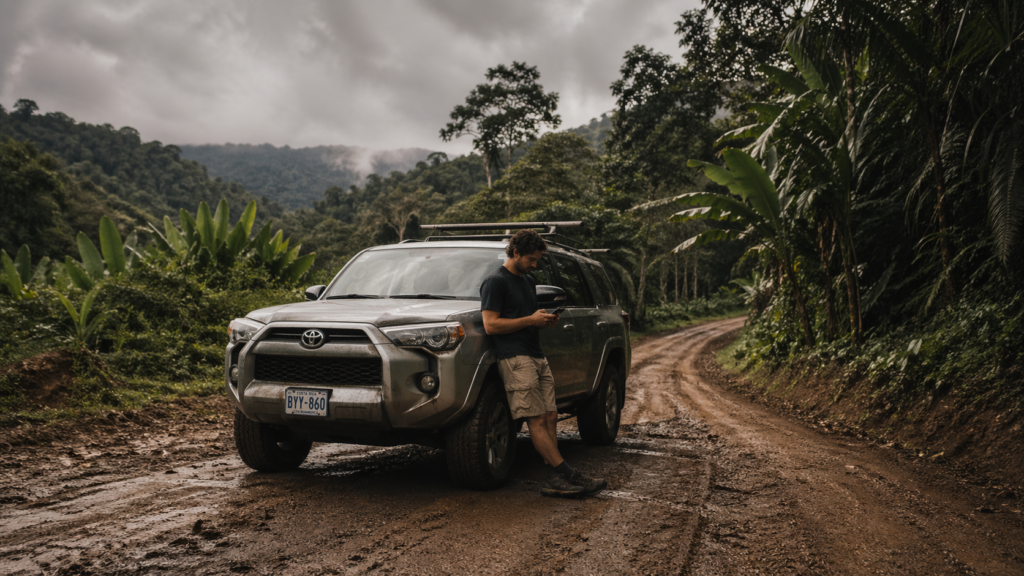
That itinerary you’ve been building the one with color-coded days, timed transfers, restaurant reservations, and carefully researched activities stacked back to back, it’s going to change. Maybe a little. Maybe completely. Not because you planned it badly. You probably planned it beautifully. It’s going to change because Costa Rica doesn’t run on itineraries. It runs on something else entirely, and the sooner you understand that, the better your trip is going to be.
I’m not saying don’t plan. I’m saying plan differently.
The road that isn’t on the map
Costa Rica’s geography is not subtle. We have two mountain ranges, a volatile volcanic spine running through the center of the country, rivers that swell overnight, and roads that would make a civil engineer cry. What looks like a two-hour drive on Google Maps can become four hours in reality, not because of traffic, but because of a pothole the size of a small swimming pool, a cattle crossing that nobody scheduled, or a bridge that handles one vehicle at a time and currently has seven trucks waiting.
Travelers who build itineraries with tight connections between destinations almost always run into trouble. The country’s infrastructure is genuinely improving, but it operates on its own timeline, which is to say: not yours.
The weather has no interest in your plans
Costa Rica has two seasons dry and rainy and both of them will surprise you. The dry season brings heat that can shut down an afternoon hike faster than any storm. The rainy season, which runs roughly from May through November depending on where you are, doesn’t rain politely on a schedule. It rains intensely, suddenly, and sometimes for days. Trails close. Roads flood. Tour operators cancel. None of this is exceptional. It’s just the climate doing what the climate does.
What catches visitors off guard isn’t the rain itself, most people know to expect it. What catches them is how completely it can reorganize a day. The waterfall you planned to visit on Wednesday is inaccessible after Tuesday’s downpour. The boat tour on Thursday gets cancelled because the sea is angry and the captain, who has been reading these waters his whole life, says no. You can argue with the captain if you want. He’s still not going.
The tico approach to weather is not resignation, it’s adaptability. You find something else to do. You sit in a soda with a coffee and watch the rain come down, and if you let yourself, you realize that this too is the trip.
Tour operators run on tico time
This phrase gets used lazily sometimes, as though it’s just an excuse for being late. It’s more nuanced than that. In Costa Rica, relationships matter more than schedules. If your tour guide stops to talk to someone he knows on the road, he’s not being unprofessional, he’s being human in a culture that prioritizes human connection over clock-watching. If the shuttle is twenty minutes late, the driver isn’t failing you. He’s operating within a system where approximate timing is culturally acceptable and rigidity is considered slightly rude.
None of this means you’ll miss everything. It means your buffer time is not optional. Build it in generously and treat it not as wasted time but as the part of the trip where the unexpected things happen, which are usually the best things.
The best stuff isn’t bookable
Here’s the part no planning app will ever tell you: the experiences that people remember most from Costa Rica are almost never the ones they scheduled. They’re the conversation with the farmer at the side of the road who turned out to be a fascinating human being. They’re the family who invited them in for coffee after they took a wrong turn. They’re the Sunday afternoon in a town square that wasn’t in any guidebook, watching kids chase pigeons while grandparents talked in the shade.
These moments cannot be put in a Google Doc. They require presence, flexibility, and the kind of open attention that over-scheduling kills. Every hour you pack with an organized activity is an hour you’re not available to let Costa Rica surprise you.
What good planning actually looks like here
Plan your anchors the places you’ll sleep, the major experiences you genuinely can’t miss, the logistics that genuinely need to be locked in advance. Book those. Then leave the rest looser than feels comfortable. Leave days with nothing on them except a general direction. Leave room for a local’s recommendation to completely reroute your afternoon. Leave room to stay somewhere longer than planned because it turned out to be exactly what you needed.
The travelers who leave Costa Rica feeling like they truly experienced something are almost never the ones who executed their itinerary perfectly. They’re the ones who were willing to let it fall apart a little and discovered that what replaced it was better.
Costa Rica will give you a great trip if you let it.
The problem is most people don’t let it.