Costa Rica has a reputation for being one of the friendliest countries in the world, and honestly, we ticos live up to that. But if you’ve ever found yourself nodding along to a conversation while having absolutely no idea what just happened welcome, friend. You’re not alone, and you’re not slow. You just haven’t been briefed on the unofficial language of Costa Rica. We don’t speak Spanish exactly the way your textbook told you we would. We speak tico, and that’s a whole other beast.
So let me walk you through ten things you’re almost guaranteed to mishear or misunderstand and what we actually mean when we say them.
1. “Tuanis” Your brain will reach for something. Two anise? Too honest? No. “Tuanis” means cool, great, awesome. If someone tells you your idea is tuanis, you’ve just received a tico stamp of approval. Use it freely. People will love you for it.
2. “Mae” This one trips up almost everyone. Tourists hear “my” and think someone is claiming ownership of something. In reality, “mae” is our all-purpose word for dude, man, buddy, or friend. It punctuates sentences, softens requests, and generally keeps the social energy warm. “Mae, qué fue?” just means “Hey, what’s up?”
3. “Qué fue” Speaking of which “qué fue” literally translates to “what was” in Spanish. You’d think something happened. Nothing happened. It’s simply how we say hello, how’s it going, what’s new. When a tico says this to you, they’re not asking you to recount past events. They’re just saying hi.
4. “Diay” This one defies clean translation, which is maybe why it sounds like noise to outsiders. “Diay” functions as a filler, an expression of surprise, an acknowledgment, and sometimes a gentle sigh all depending on tone and context. It’s the linguistic Swiss Army knife of Costa Rican Spanish. You’ll hear it constantly and never quite pin it down.
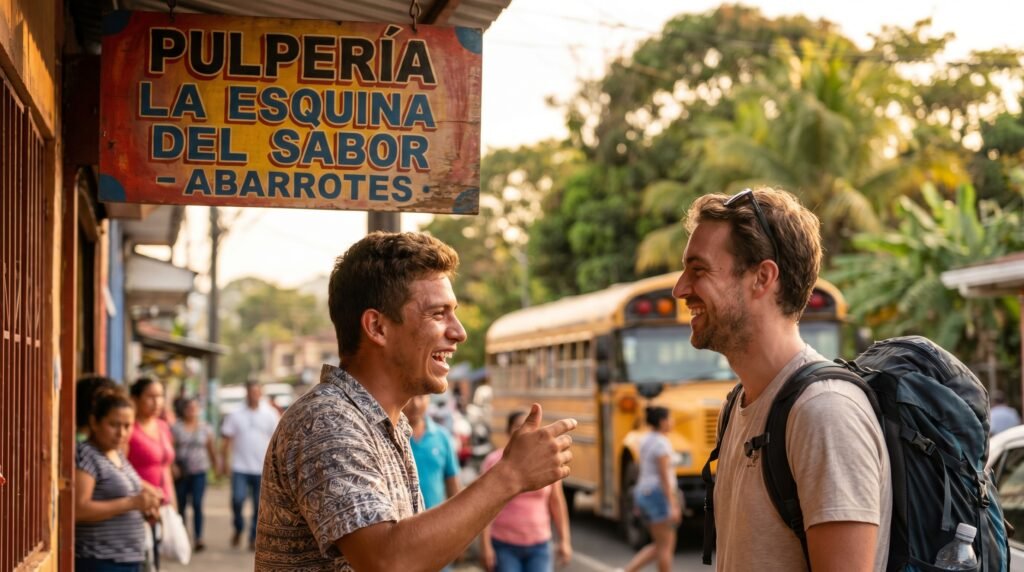
5. “Pulpería” Visitors hear this and imagine something involving octopus. The pulpería is actually the neighborhood corner store a tiny, legendary institution where you can buy bread, phone credit, cold drinks, and maybe get some local gossip included at no extra charge. Every barrio has one. Every tico has a pulpería story.
6. “Chunche” When someone hands you a chunche, they’re handing you a thing. That’s it. A chunche is any object whose name you’ve either forgotten, don’t know, or simply don’t care to specify. “Pasame ese chunche”, “Hand me that thing.” Universal, efficient, tico.
7. “Con mucho gusto” In most Spanish-speaking countries, “de nada” is how you respond to thank you. In Costa Rica, you’ll hear “con mucho gusto” instead, which means “with much pleasure.” It sounds formal but it’s just standard here. The first time you hear it, it might feel like you’ve just done someone an enormous favor. You haven’t. You just ordered a coffee.
8. “Estar de goma” This is critical information for anyone planning to enjoy Costa Rica’s social scene. “Goma” means glue, but “estar de goma” means to be hungover. The etymology is its own poetry. If you hear someone say they’re de goma, they need water, empathy, and maybe a casado. Not craft supplies.
9. “Pura Vida” Everyone thinks they know this one before they arrive. They don’t, not fully. Yes, it means pure life. But it also means hello, goodbye, you’re welcome, I’m fine, no worries, that’s great, and life is beautiful. It’s a philosophy compressed into two words. The tourists who use it correctly are the ones who’ve been here long enough to feel it, not just say it.
10. “Choza” You might hear someone refer to their choza and picture a small hut or shack. In tico speech, “choza” is just an affectionate, casual word for home, your place, your house, wherever you lay your head. It carries a warmth that the word “casa” sometimes doesn’t. Invite yourself to someone’s choza at your own risk, but know that the word itself is pure comfort.