
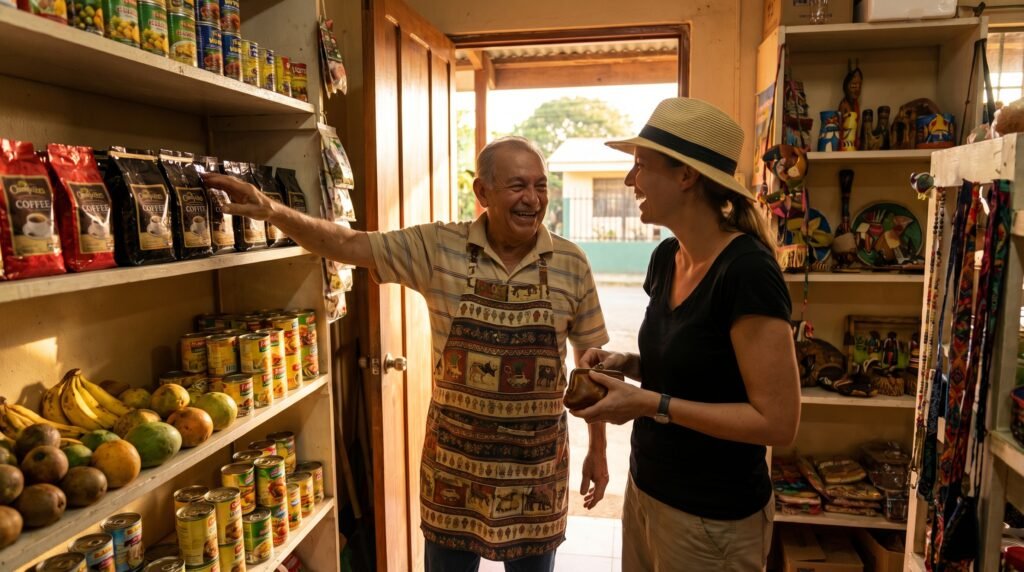
There is a moment that catches many foreigners off guard in Costa Rica.
You walk into a small business, ready to get something done quickly, efficiently, without much interaction. But instead of a fast transaction, something else happens. There is a greeting. A question. A pause. A conversation that wasn’t part of the plan.
And suddenly, what should have taken two minutes takes ten.
At first, it feels inefficient.
But over time, you begin to realize it’s intentional.
In Costa Rica, very little is purely transactional. Whether you are buying something, asking for a service, or building a professional relationship, interactions are shaped by something deeper: connection.
More Than a Transaction
In many parts of the world, daily interactions are designed for efficiency. You say what you need, you get what you came for, and you move on.
In Costa Rica, the process is different.
Before the transaction, there is recognition. A greeting. Eye contact. Sometimes small talk. It may seem like a minor detail, but it changes the entire dynamic.
You are no longer just a customer you are a person.
This shift can feel unfamiliar to foreigners, especially those coming from fast-paced environments. The instinct is to move quickly, to focus on the task, to minimize interaction.
But here, skipping the human element can make the exchange feel incomplete.
Relationships First, Business Second
One of the most defining aspects of Costa Rican culture is the importance placed on relationships.
This extends into every area of life including business.
Trust is not built instantly. It develops over time, through repeated interactions, through familiarity, through consistency. People want to know who they are dealing with, not just what they are offering.
This is why business conversations often begin with something personal.
“How are you?”
“Where are you from?”
“How long have you been here?”
These questions are not distractions. They are part of the process.
For foreigners, this can feel indirect. It may seem like the focus is drifting away from the objective. But in reality, the objective is expanding.
The relationship becomes part of the outcome.
The Pace of Connection
Because relationships matter, things often take more time.
Decisions may not happen immediately. Agreements may require multiple conversations. Processes may feel slower than expected.
This is not necessarily inefficiency it is a different kind of investment.
Time is being used to build trust.
In the long run, this often leads to stronger, more stable connections. But in the short term, it requires patience.
For foreigners used to quick results, this can be one of the most challenging adjustments.
Informality and Warmth
Another reason everything feels personal is the tone of interaction.
Costa Rican communication tends to be warm, informal, and approachable. Even in professional settings, there is often less distance between people.
Titles matter less. Hierarchies feel softer. Conversations feel more relaxed.
This can create a sense of ease but it can also blur expectations for those who are used to more structured environments.
Where does professionalism end and familiarity begin?
In Costa Rica, the two often exist together.
Saying “No” Without Saying It
The personal nature of interactions also affects how difficult conversations are handled.
Direct rejection can feel uncomfortable. Instead of saying “no” outright, responses may be softened or delayed.
“We’ll see.”
“Maybe later.”
“Let’s talk soon.”
For foreigners, this can create confusion especially in business contexts where clarity is expected.
But within the cultural framework, this approach preserves respect. It avoids tension. It keeps the relationship intact, even when the outcome is uncertain.
Understanding this is essential for navigating professional interactions.
Trust as Currency
In many places, systems and contracts drive business.
In Costa Rica, trust plays a significant role.
Recommendations matter. Personal connections open doors. Being known rather than simply being qualified can influence opportunities.
This doesn’t replace professionalism, but it adds another layer.
People prefer to work with those they trust, and trust is built through human interaction.
For foreigners, this can feel like an invisible system one that isn’t written down, but is clearly present.
The Adjustment for Foreigners
Adapting to this environment requires a shift in mindset.
It means slowing down. Being open to conversation. Allowing interactions to unfold naturally.
It also means recognizing that efficiency is not always the primary goal.
At first, this can feel frustrating especially when you are trying to accomplish something specific.
But over time, the benefits become clear.
Interactions feel richer. Relationships feel more genuine. Experiences feel less transactional.
When Business Feels Human
Perhaps the most interesting aspect of this cultural dynamic is how it transforms business itself.
When interactions are personal, business becomes less about exchange and more about connection.
Clients become familiar faces. Service providers become part of your routine. Conversations extend beyond the immediate need.
And while this may not always be the fastest way to operate, it creates something else, something more sustainable.
Final Thoughts
Understanding why everything feels personal in Costa Rica is not about adjusting your expectations of business it’s about expanding your understanding of connection.
It reveals a culture where relationships are not separate from transactions, but embedded within them.
Where time is not only used to complete tasks, but to build trust.
And where even the simplest interaction carries a human element.
Because in Costa Rica, business is never just business.
It’s always, in some way, personal.