
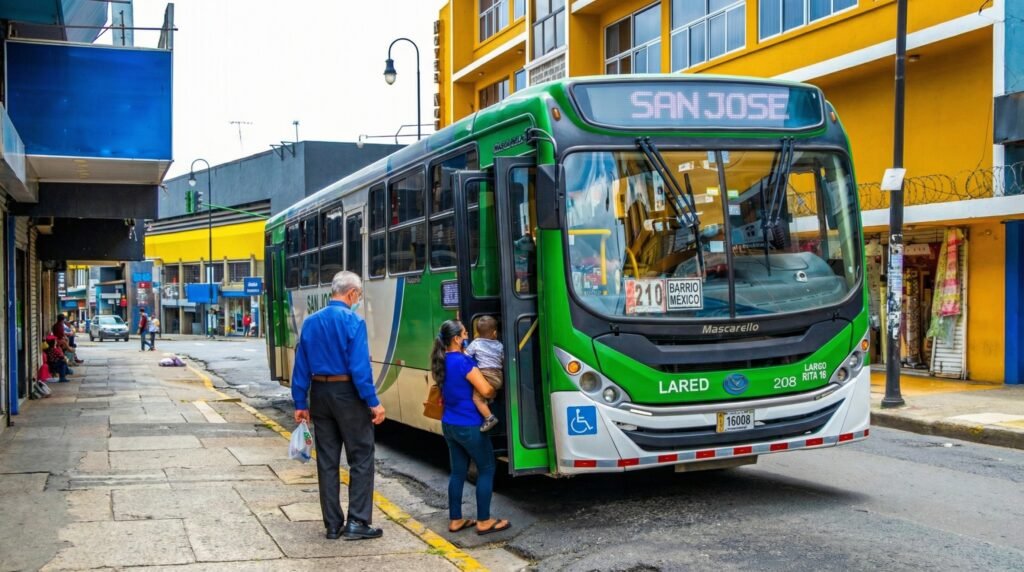
If you read about public transportation in Costa Rica before visiting, you’ll likely come across phrases like “affordable,” “extensive,” and “easy to use.” Technically, none of those descriptions are wrong. But they’re also incomplete.
As someone who has lived in San José my entire life working, commuting, and navigating the system daily I can tell you that public transportation here is less about infrastructure and more about adaptation. It works, but not in the structured, predictable way many foreigners expect.
The first thing to understand is that Costa Rica does not have a unified public transportation system. There is no central network where everything connects seamlessly. Instead, what exists is a collection of private bus companies operating different routes, each with its own schedules, stops, and internal logic. From the outside, it can feel fragmented. For locals, it’s something we learn over time almost like an informal system passed down through experience rather than clearly explained rules.
In San José, buses are the backbone of daily movement. For many middle-class families, owning a car is common, but not always practical. Traffic congestion, limited parking, and rising fuel costs make buses a necessary alternative. Even people who have cars will sometimes choose the bus, especially when heading into the city center.
But using the bus is not just about getting from point A to point B. It requires a certain level of awareness that isn’t obvious at first. Bus stops, for example, are not always clearly marked. In some areas, they exist more as “known spots” than official stations. You learn them by seeing where others wait. And if you’re unsure, you ask. That interaction brief, casual, and direct is part of the system.
Schedules are another reality that often surprises visitors. While some routes follow relatively consistent timetables, many operate with a level of flexibility that reflects real-world conditions. Traffic plays a major role. A bus that should arrive at 8:10 might come at 8:05 or 8:20, depending on congestion, weather, or even the time of year. For locals, this uncertainty becomes normal. You don’t expect precision you build time around the possibility of delay.
During peak hours, especially in the mornings and late afternoons, buses become crowded. This is not a rare occurrence; it is the daily norm. People stand, shift, adjust, and make space. There’s an unspoken understanding of how to coexist in a limited space. It’s not always comfortable, but it’s functional.
What many tourists don’t realize is that this experience is deeply tied to social dynamics. Public transportation in Costa Rica reflects the rhythm of everyday life. Students, workers, vendors, and retirees all share the same space. Conversations happen, music plays softly from someone’s phone, and the driver navigates not just traffic but a constantly changing flow of passengers.
Payment methods have evolved over time, but they are not yet fully standardized. Some buses accept cards, others require cash, and in certain cases, exact change is still expected. This inconsistency can be confusing for visitors, but for locals, it’s just another variable to manage. You learn to carry small bills or coins, just in case.
Safety is another aspect that deserves a realistic perspective. Public transportation in Costa Rica is generally safe, especially during the day and in well-traveled routes. However, like in any urban environment, awareness matters. Pickpocketing can happen, particularly in crowded buses. Locals are used to keeping an eye on their belongings without making it a constant source of stress. It’s not paranoia it’s habit.
One of the most overlooked aspects of public transportation here is how much it shapes daily routines. People don’t just “take the bus”—they organize their lives around it. Work schedules, school times, and even social plans are influenced by available routes and travel times. A trip that looks short on a map can take significantly longer in reality, especially if it involves transfers.
And that brings up another important point: transfers are not always straightforward. Unlike systems where you can switch lines within a single station, here you often have to get off, walk, and find another stop sometimes several blocks away. Again, this is something locals navigate with experience, not instructions.
Despite all of this, public transportation remains essential. It connects communities, supports daily life, and provides access to opportunities. It may not be efficient by international standards, but it is deeply integrated into how the country functions.
For visitors, the challenge is not just learning how to use it, but adjusting expectations. If you approach it expecting precision, structure, and clear guidance, you’ll likely feel frustrated. But if you approach it with flexibility, patience, and a willingness to observe, it becomes something else entirely a window into how Costa Rican society actually operates.
In many ways, public transportation here reflects a broader cultural pattern. Things are not always optimized, but they work. Not perfectly, not predictably, but consistently enough to be relied on. And that reliability is built not just on systems, but on people drivers who know their routes by memory, passengers who help each other, and a shared understanding that getting somewhere is often a collective effort.
So when people ask whether public transportation in Costa Rica is “good” or “bad,” the answer depends on what you expect. It’s not designed for convenience in the way many developed systems are. But it is functional, accessible, and deeply human.
And that, more than anything, is what no one really explains.