
For many travelers, Costa Rica introduces itself through landscapes lush jungles, soft rain, and warm light filtering through the mountains. But beyond the scenery, there is something less visible, yet equally powerful, shaping everyday life: the way time is understood.
It doesn’t take long for foreigners to notice that something feels different. Plans unfold more loosely. Conversations stretch longer than expected. And words that seem precise at first reveal themselves to be anything but. The confusion doesn’t come from a lack of timekeeping it comes from a different relationship with time itself.
One of the first encounters with this shift often comes through a simple word: ahorita. On paper, it means “right now.” In practice, it carries a much softer meaning. It might signal that something will happen soon, later, or simply at some undefined point in the near future. For someone used to exact timing, this ambiguity can feel disorienting. But within the local context, it’s not about precision it’s about intention. It acknowledges action without locking it into a rigid moment.
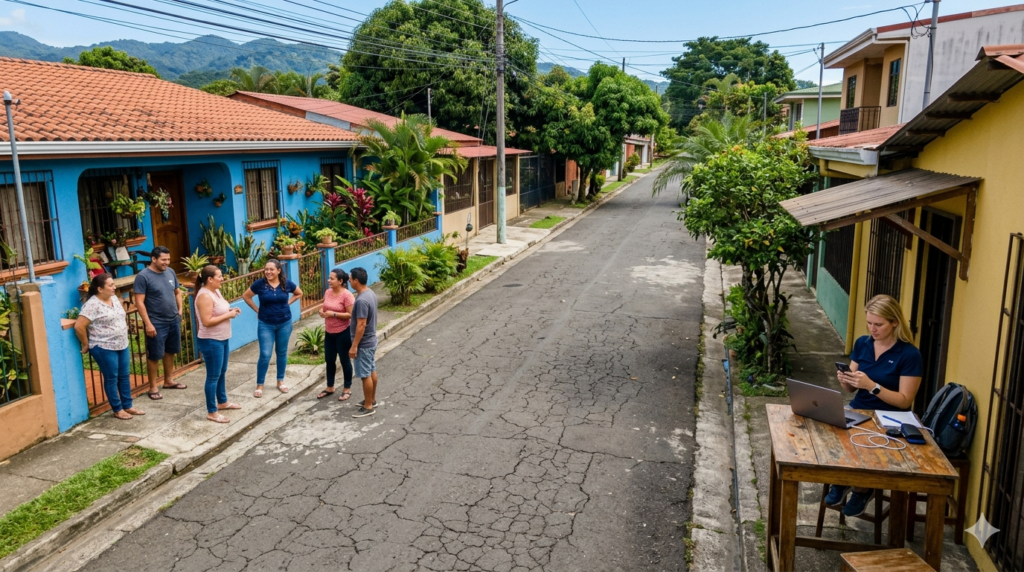
This fluidity extends beyond language and into daily interactions. In many parts of the world, punctuality is a reflection of respect. In Costa Rica, that idea exists, but it is interpreted through a more relaxed lens. Social gatherings, in particular, operate on an unspoken flexibility. An invitation for mid-afternoon doesn’t necessarily mark a fixed starting point, but rather a general window of arrival. Time becomes less about exactness and more about presence.
For foreigners, this can create a sense of instability. Plans that felt clear may shift or dissolve altogether. A meeting might move, a visit might extend, a simple errand might take far longer than anticipated. Yet, beneath this apparent unpredictability lies a quiet consistency. Life here tends to respond to the moment rather than forcing the moment to fit a plan.
There is also a different way of communicating uncertainty. Phrases like “tal vez”, “ahí vemos”, or “después hablamos” are common, and they often leave foreigners searching for clarity. These expressions are intentionally open-ended. Rather than delivering a direct refusal, they preserve harmony and keep possibilities alive. What may seem vague is, in many ways, a form of social balance.
At the heart of this experience is a deeper distinction: time in Costa Rica is often relationship-centered rather than task-centered. In more structured environments, time is organized around productivity what needs to be done, how quickly it can be achieved, how efficiently it can be completed. Here, time tends to expand around people. A short interaction can evolve into a meaningful conversation. A planned visit can naturally extend into something unhurried and unplanned.
This shift can feel inefficient at first. Waiting becomes more frequent waiting for food, for services, for people. The pace slows down, sometimes without explanation. But over time, what initially feels like delay begins to reveal itself as a different rhythm. One that allows space for connection, for spontaneity, and for simply being present.
Much of this perspective is captured in a phrase that foreigners quickly learn: Pura Vida. While often translated simply as “pure life,” its meaning runs deeper. It reflects an attitude toward living one that values ease over urgency and experience over control. When applied to time, it softens expectations. It invites patience. It removes the constant pressure to optimize every moment.
In this context, not everything needs to be scheduled in advance. Some of the most meaningful experiences happen without planning at all. A chance encounter can shape an entire afternoon. A casual conversation can lead somewhere unexpected. The day is not always something to be managed it is something to be lived.
What confuses foreigners most, then, is not the absence of structure, but the presence of a different set of priorities. Costa Rican time is not disorganized it is simply guided by values that may feel unfamiliar at first. Flexibility replaces rigidity. Connection takes precedence over efficiency. Presence becomes more important than precision.
Understanding this doesn’t happen instantly. It unfolds gradually, often through moments of mild frustration that eventually give way to acceptance. And for many, something shifts along the way. The need to control time begins to loosen. The pace becomes less urgent. The experience becomes richer.
In the end, Costa Rican time isn’t about losing time it’s about relating to it differently. And for those willing to adjust, it offers something rare: the chance to step out of the constant rush and into a way of living where time feels less like something to manage, and more like something to experience.