
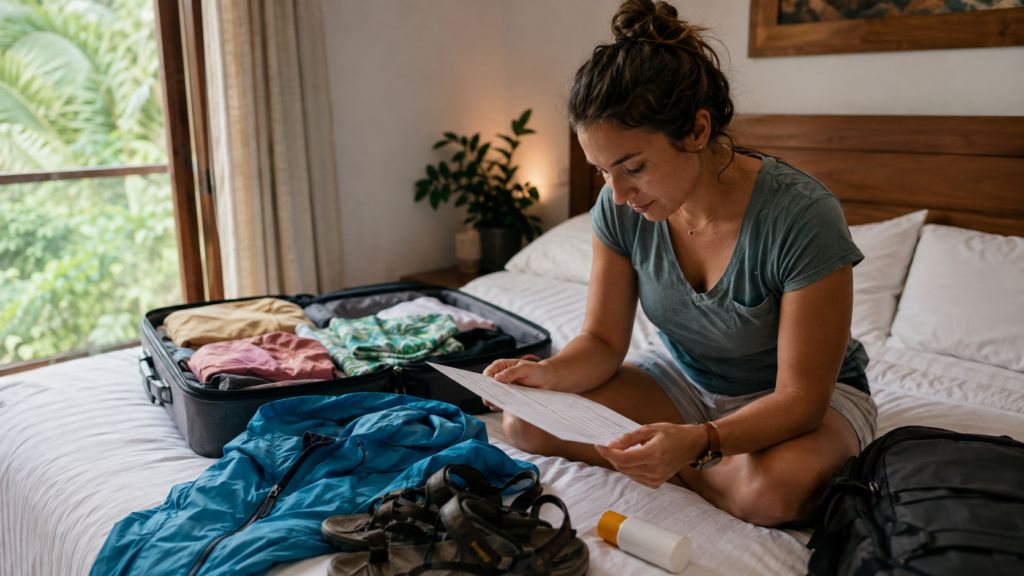
Every year, thousands of tourists arrive at Juan Santamaría International Airport in San José with luggage that tells the same story before they even open it. The story goes like this: someone read a packing list on the internet, bought several items they had never owned before and packed for a version of Costa Rica that exists somewhere between a nature documentary and a resort brochure. What they did not pack for is the actual country; a place with a capital city that gets genuinely cold at night, a cloud forest that will soak through almost any jacket given enough time, rural towns where showing up in beachwear is genuinely uncomfortable for the people who live there, and an afternoon rain season that does not wait for you to finish your lunch.
The single most common packing mistake has nothing to do with what people bring and everything to do with what they assume. Most visitors plan their wardrobe for one climate and then travel through four. Costa Rica is not a uniform tropical paradise where the same tank top and sandals carry you through every situation. The Pacific coast around Guanacaste runs genuinely hot and dry from December through April, but Monteverde, sitting at over 1,400 meters in the cloud forest, can drop to 14 or 15 degrees Celsius on a rainy afternoon. San José at night in December is sweater weather. The Caribbean side around Puerto Viejo operates on its own meteorological schedule entirely, raining when the rest of the country is dry and clearing up when everything else is wet. Most packing lists do not tell you this because most packing lists are not written by people who actually live here.
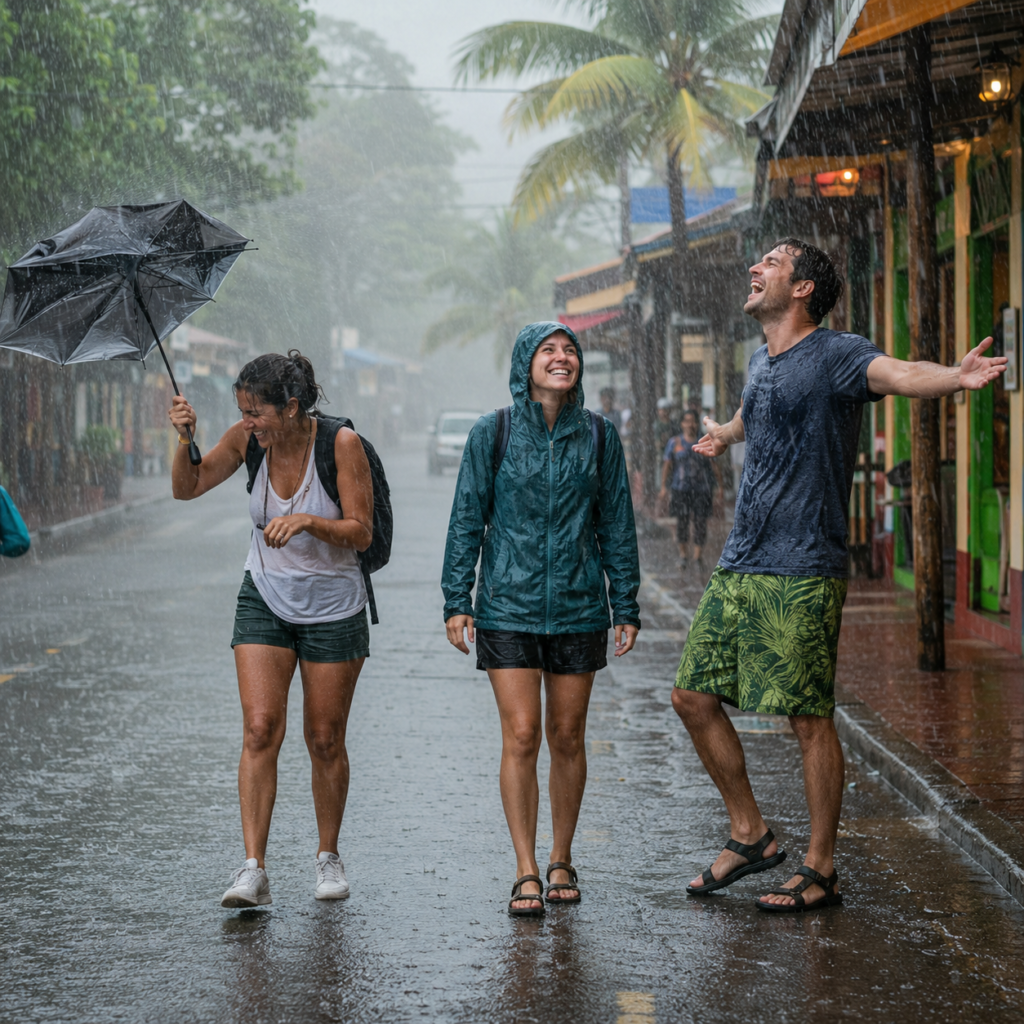
Rain gear is where the errors get expensive. Umbrellas are not the answer. They collapse in the wind on a forest trail, they leave your legs soaked anyway and locals barely use them; most Ticos simply wait out a downpour under the nearest roof, which is a perfectly viable strategy when you understand how Costa Rican rain works. The afternoon rains in green season, roughly May through November, are typically intense and short, forty-five minutes to an hour, followed by clear skies. What you actually need is a lightweight packable rain jacket that fits in a bag pocket. Something waterproof, not water-resistant, because water-resistant becomes useless within about ten minutes of a proper Costa Rican aguacero. One jacket. That is the entire rain strategy.
Footwear is the second major miscalculation. The tourists who bring only flip flops discover their limits the first time they try to walk on a muddy rainforest trail after rain, which is most rainforest trails most of the time. The tourists who bring heavy leather hiking boots discover that their feet are soaked within an hour anyway on a proper river crossing, that the boots take two days to dry and that they weigh about half a kilogram each. What actually works in Costa Rica is a pair of sturdy sandals with ankle support, something like a Teva or Keen, plus one pair of lightweight closed-toe sneakers for towns and evening walking. If you are doing serious hiking in Chirripó or the remote Osa Peninsula, actual trail shoes make sense. For everything else, you are overcorrecting.
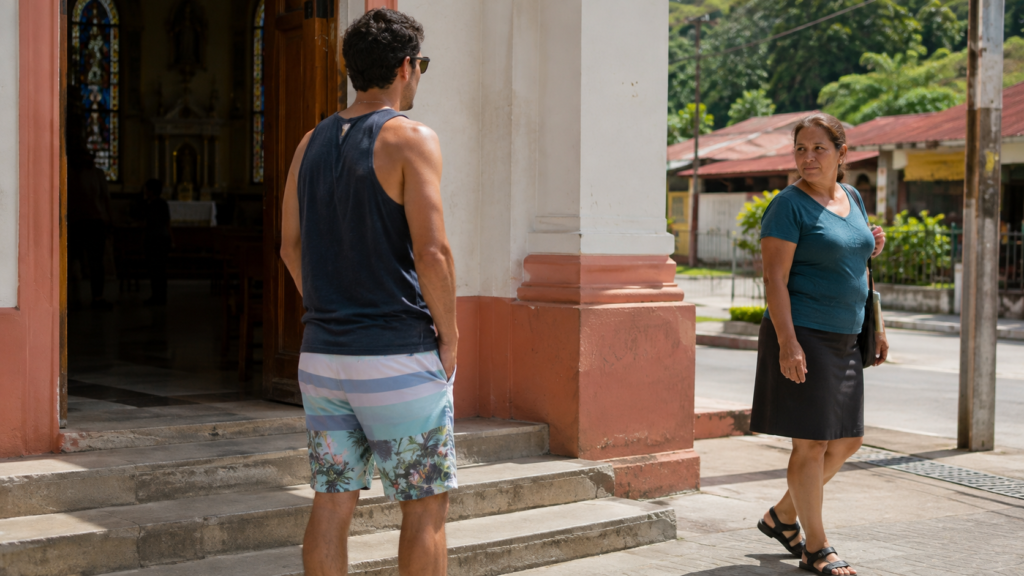
The dress code issue is the one that creates actual social friction, and almost no packing list mentions it. Costa Rica’s tourist zones, Tamarindo, Manuel Antonio, La Fortuna, are relaxed about clothing because they have adapted to the expectations of foreign visitors. But drive twenty minutes inland from any of those beach towns and you are in a different social register entirely. Small towns in the Central Valley, rural communities in Guanacaste, churches anywhere in the country, these are places where arriving in short shorts and a bikini top is noticed, and not positively. Locals dress with a degree of care that surprises most visitors. Clean clothes, reasonably modest coverage, nothing that looks like you just walked off a boat. This is not prudishness; it is a social code around presentation and respect that the country practices quietly and consistently.
What people consistently overpack is formal or semi-formal clothing. Costa Rica is not that kind of destination. Unless you are attending a specific business event or a wedding, the nicest outfit you will need for a restaurant dinner is a clean shirt and decent trousers or a simple dress. Nobody is showing up to even a mid-range San José restaurant in a blazer. The space in the suitcase taken up by two dress shirts and a pair of leather shoes is almost always wasted, and it comes at the cost of not having room for the things that actually matter.
Toiletries follow their own logic here. Sunscreen is available in Costa Rica but genuinely expensive, sometimes two or three times what you would pay in the United States or Europe, and the SPF options are more limited outside of San José supermarkets. Bring more than you think you need, including a lip balm with sun protection, because the tropical sun at low altitude on the Pacific coast is considerably more aggressive than most visitors from temperate climates expect. Insect repellent is widely available but quality varies; if you are going into the jungle, near standing water or to the Caribbean coast, bring DEET-based repellent from home because the alternatives in small-town pharmacies tend to be decorative at best.
Electronics are simple. Costa Rica runs on 110 volts with standard North American plugs; European visitors need a basic adapter, easier to buy before leaving than to find in a small Costa Rican town at 9 PM with a dead phone. Cell coverage is solid in tourist areas and most lodges have workable internet. The remote Osa Peninsula and parts of the Caribbean coast are exceptions, and being genuinely offline for a few days there is, depending on your temperament, either the worst or the best thing about them.
A few things are best left at home. Expensive jewelry is the obvious one; Costa Rica’s petty theft in tourist areas is real and no situation here requires a gold watch. White clothes are a subtler mistake; red mud, humidity and roadside puddle splashes turn white to terracotta faster than you expect. And the brand new everything approach, fresh boots, tags-on rain jacket, never-worn cargo pants, tends to signal to locals that the visitor packed for a performance of Costa Rica rather than for the actual place.
The packing list that actually serves you in Costa Rica is shorter and lighter than you think. Two pairs of comfortable walking shoes, a rain jacket that fits in your pocket, clothes that cover more than beachwear for the days you spend in towns rather than on beaches, more sunscreen than seems necessary and a willingness to buy anything you forgot at one of the country’s perfectly functional pharmacies or supermarkets. Everything else is weight. And in a country where the best moments tend to involve unplanned walks down unmarked roads and spontaneous stops at roadside sodas, traveling light is not just practical; it is the correct attitude.