
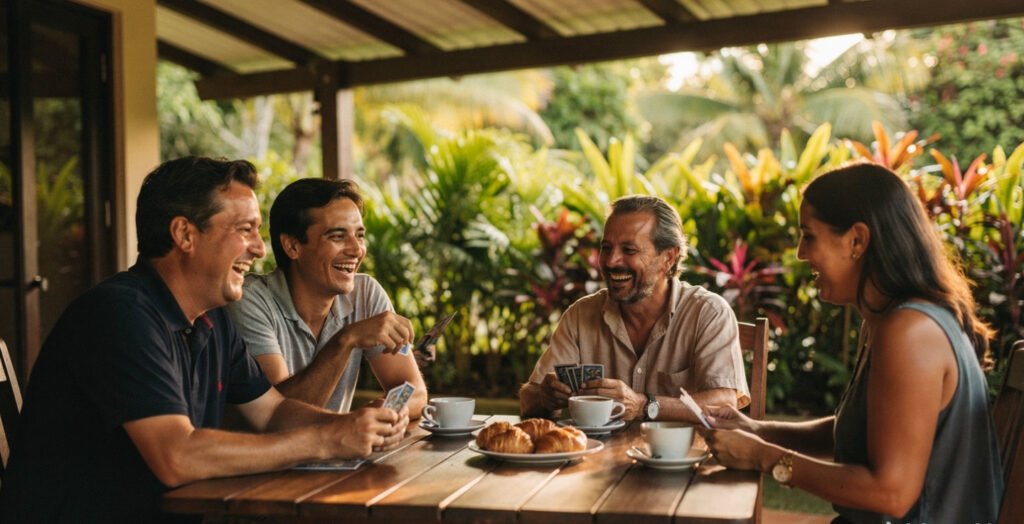
In the 2026 World Happiness Report, produced by Gallup and the University of Oxford’s Wellbeing Research Centre, Costa Rica ranked fourth happiest country in the world, climbing from a low of twenty third place just three years earlier and entering the global top five for the first time in the history of the report. No other Latin American nation has ever reached this position. The ranking is not based on smiles or sunshine; it is based on how millions of people across more than one hundred forty countries rate the actual quality of their own lives, combined with measured factors like social support, healthy life expectancy, freedom, generosity, and trust in institutions.
This is the part most outsiders find genuinely puzzling. Costa Rica is not among the world’s wealthiest nations. Its GDP per capita sits well below most of the countries surrounding it on the list. And yet, year after year, Costa Ricans report a quality of life that rivals and now exceeds nations with dramatically more resources. The report itself treats this as one of its central findings, that happiness is not simply a function of money, and that Costa Rica is one of the clearest living examples of that finding.
I am Costa Rican, I am thirty five years old, and I have spent my entire life inside the culture that this report is now measuring from the outside. I did not grow up thinking of my country as unusually happy; I grew up inside the ordinary frictions of traffic, bureaucracy, and economic pressure that exist here just as they do everywhere else. What this article attempts to do is explain, honestly and specifically, what is actually behind the number, because the explanation is more interesting and more instructive than the ranking alone.
This is not a celebration piece. It is an analysis, written from the inside, of what a culture has to actually do, structurally and daily, to produce results like this.
There is a strange experience that happens to many Costa Ricans when international rankings like this one are published, a kind of double take that mixes pride with genuine confusion. The same friend who is stuck in traffic for ninety minutes every morning, the same coworker who is still waiting on a CAJA appointment scheduled months ago, the same neighbor managing the rising cost of groceries, reads that their country has been ranked one of the happiest on earth and thinks, with real sincerity, compared to what exactly. The confusion is not cynicism. It is the natural reaction of people living inside ordinary daily friction who did not realize that friction and happiness, measured properly, are not actually opposites.
The World Happiness Report does not ask people whether their lives are easy. It asks them to evaluate the overall quality of their lives on a scale, and then it looks at the structural and social conditions that tend to produce high evaluations across large populations. Costa Rica’s strength is not the absence of hardship. It is the presence of specific social and institutional conditions that consistently buffer hardship in ways that other countries, even wealthier ones, often fail to replicate.
Social support that is structural, not occasional
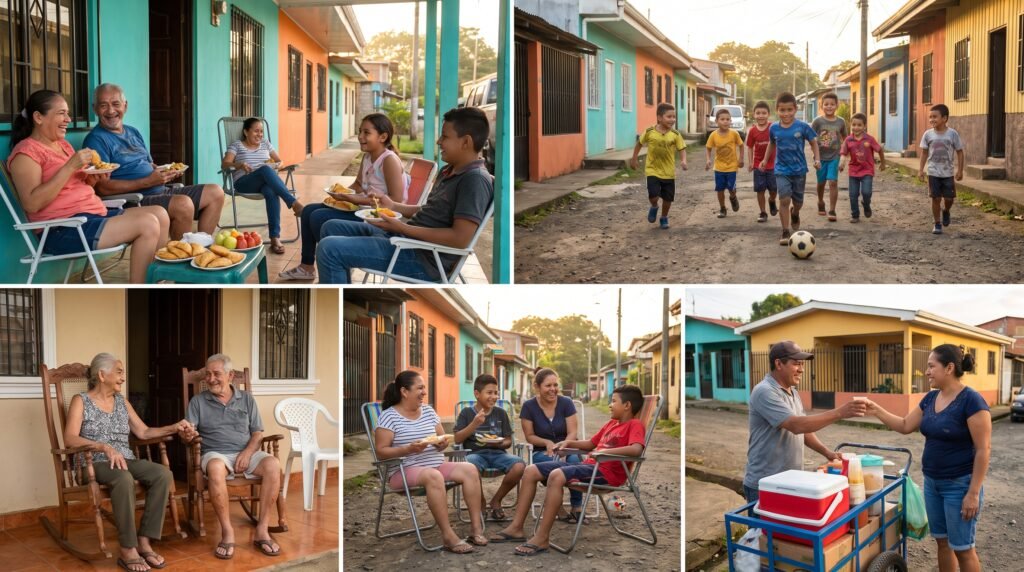
The single factor the report weights most heavily, alongside life evaluation itself, is social support, and Costa Rica scores exceptionally well on this measure because the extended family and community networks described throughout this site’s culture coverage are not occasional gestures here, they are structural. A Costa Rican in crisis is rarely facing that crisis alone, because the family system, the neighborhood system, and the broader cultural expectation of mutual aid activate quickly and reliably. This is measurable. It shows up in survey responses about whether people have someone to count on, and Costa Rica’s answers to that question are consistently among the strongest in the world.
A small country with a long democratic memory
Costa Rica abolished its military in 1948 and has maintained uninterrupted democratic governance for more than seven decades, a political stability that is rare in its region and that produces a baseline sense of security that wealthier but more volatile nations often lack. The report consistently finds that trust in institutions and freedom from corruption correlate strongly with happiness, and Costa Rica, while not without its institutional frustrations, scores well on these measures relative to its income level. People do not need to be wealthy to feel secure. They need to believe the systems around them are not fundamentally working against them, and most Costa Ricans, most of the time, believe exactly that.
“Costa Rica’s happiness is not the absence of hardship. It is the presence of specific social and institutional conditions that consistently buffer hardship in ways that even wealthier countries often fail to replicate.”
Generosity and the habit of helping strangers
The 2025 and 2026 editions of the report placed unusual emphasis on benevolence, the measurable rates at which people donate, volunteer, and help strangers, and found that expecting kindness from others predicts happiness more strongly than avoiding major negative events. Costa Rica performs strongly here, consistent with a culture in which greeting strangers warmly, offering unsolicited help, and extending hospitality without expectation of return are daily, normalized behaviors rather than exceptions. This is not an abstract value. It shows up in the lived experience of simply moving through a Costa Rican day, where the baseline expectation is that people around you will generally be kind, and that expectation, repeated millions of times across a population, becomes a measurable national trait.
Health, longevity, and a system that, despite its flaws, works
Costa Rica’s public healthcare system, the CAJA, is frequently criticized by Costa Ricans themselves for long wait times and bureaucratic friction, and that criticism is fair. What it obscures is that the system provides genuine universal coverage, has contributed to a life expectancy that exceeds the United States, and removes the specific, chronic anxiety around medical bankruptcy that shapes daily stress levels in countries without similar coverage. The Nicoya Peninsula’s recognition as one of the world’s Blue Zones, regions with unusually high concentrations of long, healthy lives, is not an isolated curiosity; it reflects broader patterns of diet, community connection, and purpose that extend, in varying degrees, across much of the country.

A culture that practices presence as a daily discipline
Pura vida is the phrase that gets exported, and it is frequently dismissed by skeptical observers as marketing. The honest version is more interesting than either the slogan or the dismissal. Pura vida, practiced seriously, is a daily discipline of choosing presence over anxiety, of refusing to let stress dominate the emotional register of an ordinary interaction, of greeting difficulty with the same warmth extended to everything else. This is not the absence of stress. It is a trained response to stress that, repeated across an entire population for generations, produces measurably different self reported wellbeing than cultures that organize themselves around urgency and individual achievement instead.
What the ranking gets right, and what it does not capture
It would be dishonest to present this ranking as the whole story. Costa Rica has real economic inequality, real housing pressure in the Central Valley, real frustrations with bureaucracy and infrastructure, and real generational anxiety among young people facing a harder economic climate than their parents did. The happiness measured by this report is an average across millions of individual experiences, and averages always conceal real variation and real struggle underneath them.
What the ranking captures correctly, in my own lived experience of this culture, is that Costa Rica has built, often without naming it explicitly, a set of social habits, family structures, and institutional choices that consistently soften the edges of ordinary hardship. The happiness is not a feeling that descends from the climate or the scenery. It is the cumulative result of a culture that decided, generations ago, that social connection, basic security, and daily kindness mattered enough to organize a country around them, and has kept choosing that, year after year, even when it would have been easier not to.
Related topics
Why Digital Nomads Are Choosing Costa Rica
The Role of Coffee in Costa Rican Daily Life
How Costa Ricans Use “Usted” With Everyone And Why It’s Not Formal at All