
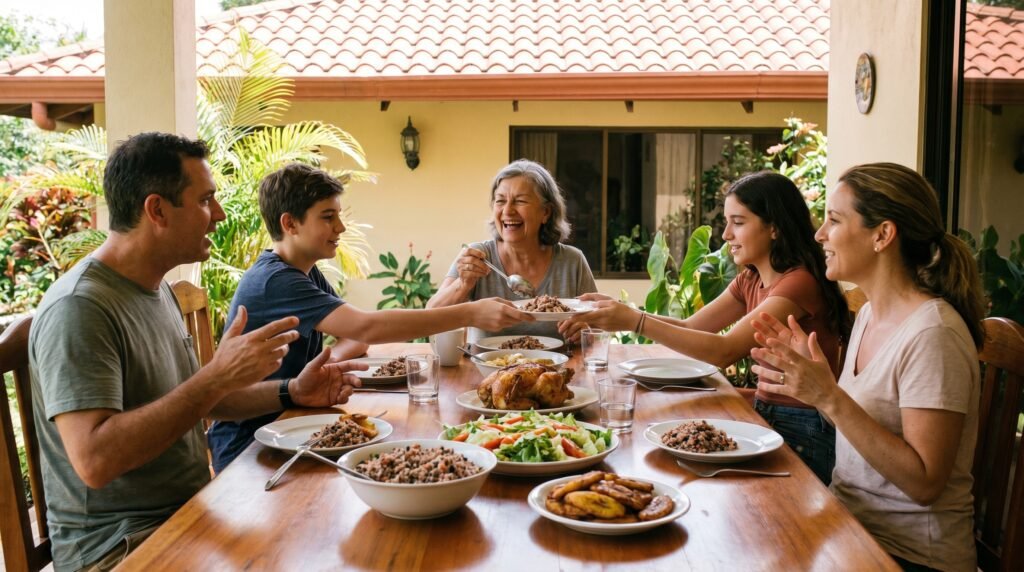
Every culture says it values family. Costa Rica actually organizes its entire social architecture around it. The difference between those two things is not rhetorical; it is visible in how neighborhoods function, how professional networks are built, how crises are absorbed, and how the week arranges itself around a Sunday lunch that is, in most Costa Rican households, the social event that everything else accommodates.
I grew up in a house in Heredia where the concept of “family” extended well beyond the people who slept under the same roof. It included grandparents who lived ten minutes away and appeared without warning at mealtimes, aunts and uncles who had opinions about every decision made by every member of the family and expressed those opinions freely, cousins who were treated with the same intimacy as siblings, and a godmother who functioned, in practice, as a second mother with full authority and unlimited access. That extended constellation was not unusual. It was the norm, and it remains the norm today.
Foreigners who visit or move to Costa Rica frequently remark on the warmth of the people without fully understanding where that warmth comes from. Much of it comes from here: from a culture that has spent generations practicing the specific social skills that family life demands, including patience, tolerance, the subordination of individual preference to group need, and the daily exercise of showing up for people whether or not it is convenient.
This article explains the role of family in Costa Rican culture with the specificity it deserves; not as a feel-good observation about “family values,” but as a genuine cultural analysis of why family occupies the center it does, what that centrality costs, and what it gives back.
Understanding this one dimension of Costa Rican life illuminates almost everything else about the country. It is that foundational.
There is a moment that happens reliably at every Costa Rican family gathering, usually somewhere between the second helping of rice and the arrival of the coffee, when the conversation becomes simultaneously too loud, too personal, and too important to stop. Someone is giving advice that was not requested. Someone else is defending a decision the entire table has already judged. A child is being held by an aunt while its mother argues with a cousin about something that happened three Sundays ago. The grandmother is refilling plates without asking because the question of whether anyone wants more food is not a question she considers worth asking. And in the middle of all of it, there is a quality of presence, of density, of mutual accountability that is almost impossible to find anywhere else in ordinary life. That is the Costa Rican family, operating at full capacity. It is not always comfortable. It is almost always necessary.
Understanding why family occupies the position it does in Costa Rican culture requires understanding what the family actually does here, beyond the obvious functions of biology and domestic organization. In Costa Rica, the extended family is a social infrastructure; it is the network through which trust is established, resources are distributed in moments of crisis, reputations are maintained, children are collectively raised, elderly relatives are cared for, and the emotional maintenance of every individual member is collectively managed. It does the work that in other cultures is distributed across a much wider set of institutions, from professional therapy to formal social services to neighborhood associations. Here, the family absorbs most of it.
The extended family as the operating network
The Costa Rican concept of family does not stop at the nuclear unit of parents and children. It extends outward through grandparents, aunts, uncles, and cousins in the first ring; through godparents, close family friends, and the families of spouses in the second; and through a web of social connections that are maintained with enough consistency to function, in practice, like family even when they are not. The godparent relationship, in particular, carries real social weight; a godparent in Costa Rica is not a ceremonial title but a genuine secondary parent, one who is expected to be present at milestones, available in crises, and invested in the child’s development in ways that go beyond the symbolic.
This extended network means that most Costa Ricans move through their social world inside a web of relationships that precede them; they arrive at jobs, neighborhoods, and social situations already connected to people through chains of family and quasi-family links that establish a baseline of trust before any direct relationship has been built. A colleague who turns out to be the cousin of your mother’s closest friend is not a stranger who happens to share a workplace; they are, within the logic of this culture, already someone you have an obligation toward and a claim on. That dynamic shapes how professional relationships develop, how favors are exchanged, how conflict is managed, and how loyalty is allocated across the various contexts of adult life.
Sunday lunch as social institution
If there is a single ritual that makes the centrality of family visible and legible to an outside observer, it is the Sunday lunch at the family home. In most Costa Rican households, this is not an occasional tradition or a holiday event; it is a weekly institution, as reliable and as structurally important as any formal appointment on the calendar. The grandmother’s house, or the parents’ house, or whichever family node has assumed the role of gathering point, prepares food for a number of people that is always larger than expected and always somehow sufficient. People arrive at different times and are absorbed into the gathering without ceremony. Children run between rooms. Men watch football or talk about football or argue about football with the same intensity they bring to both activities. Women, in many households, are still disproportionately responsible for the kitchen, a dynamic that younger generations are renegotiating with variable success and ongoing negotiation.
“The Sunday lunch is not a meal. It is a weekly renewal of the social contract that holds the extended family together; a collective act of presence that says, without words, that everyone in the room still belongs to each other.”
What the Sunday lunch provides, beyond the obvious pleasure of shared food and familiar company, is a regular accountability structure. It is the moment when everyone checks in; when the cousin who has been struggling is seen by people who will notice, when the grandmother who has been lonely is visited by people who belong to her, when the family’s collective intelligence about the state of each of its members is updated and acted upon. It is, in the most practical sense, a social welfare system that operates on love rather than bureaucracy, and its regularity is the feature that makes it work.
What family costs, and what it gives
The centrality of family in Costa Rican culture is not without its weight. The same network that provides support also provides surveillance; the same people who show up when you need them also have opinions about your decisions, your relationships, your career choices, and the way you are raising your children, and they express those opinions with a directness that the culture’s general preference for indirection does not seem to apply to family matters. Privacy, in the Northern European sense of a protected personal sphere into which others do not have access without invitation, is a more complicated concept inside a family system this dense and this present.
There is also the obligation dimension; the expectation that you will be available for family events, that you will contribute to family needs, that you will subordinate individual plans to collective ones when the situation demands it. A Costa Rican who consistently prioritizes personal plans over family commitments is making a social statement that the family registers and responds to, not always with explicit confrontation but with the particular form of social pressure that dense relational networks apply naturally and without coordination.
And yet the cost is, for most Costa Ricans, worth it in ways that become visible primarily in moments of difficulty. When something goes wrong, the family network activates with a speed and a comprehensiveness that formal support systems rarely match. A medical emergency, a financial crisis, a relationship breakdown, a professional failure; any of these will, in a functioning Costa Rican family, produce an immediate mobilization of resources, presence, and practical assistance that most people in more individualistic cultures would have to pay for or do without. The family is expensive in ordinary times and invaluable in extraordinary ones, and most Costa Ricans have internalized that trade with enough clarity to consider it not a sacrifice but a rational investment.
What this means for the foreigner who wants to understand it
For a foreigner living in or visiting Costa Rica, the centrality of family has practical implications that go beyond the sociological. It means that being introduced into a Costa Rican’s family network is a significant social event, one that carries real meaning and real obligations on both sides. It means that understanding someone’s family situation, the relationships that structure their week and their obligations, is essential to understanding them as a person rather than simply as a professional or a social contact. It means that the invitation to Sunday lunch is not a casual gesture; it is an offer of inclusion in the most important social unit in the culture, and it should be received accordingly.
The warmth that foreigners consistently identify as one of Costa Rica’s most distinctive qualities is not a natural resource that the country happens to be endowed with; it is a skill that is cultivated, over years, inside family systems that demand its daily practice. The Costa Rican who greets you with genuine warmth learned that warmth at a family table, in the specific social school of people who have known each other too long and too well to be anything but honest, and too deeply connected to be anything but kind. That is the source. The Sunday lunch is where it is renewed.