
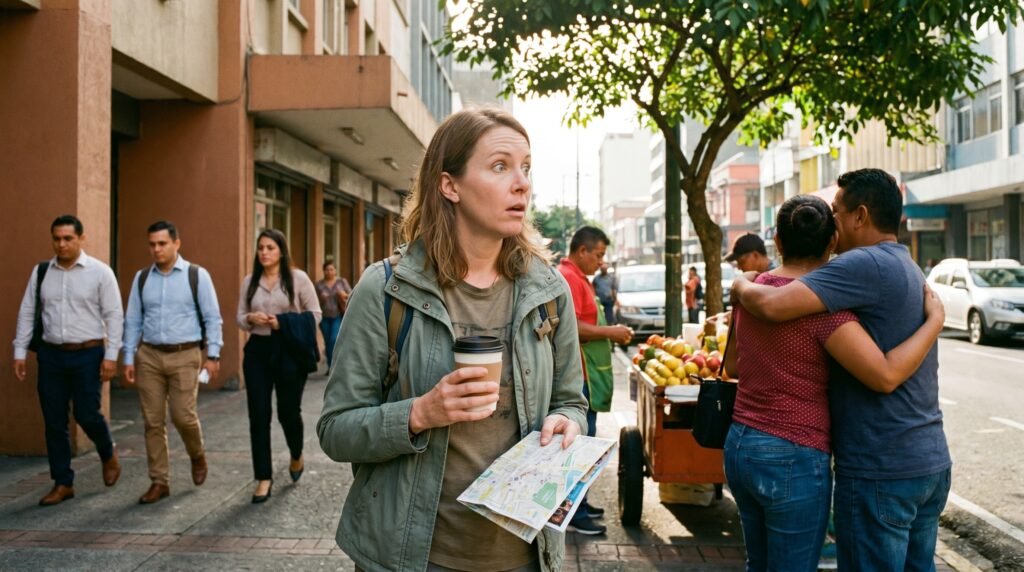
The first hours and days in a new country reveal things that years of living there make invisible. Here is what foreigners consistently see when they arrive in Costa Rica and what a local sees when he watches them see it.
There is a particular clarity that belongs only to the first few days in a foreign country, a sharpness of observation that fades quickly once the unfamiliar becomes familiar. A newcomer to Costa Rica notices things that a thirty-five-year resident like me stopped noticing decades ago: the way every person in a room gets greeted individually, the specific sound of a bus horn at six in the morning, the smell of gallo pinto coming through a window that has no glass in it because in this climate glass in windows is often optional.
I have spent years watching foreigners arrive in Costa Rica and paying close attention to what stops them, what produces that slight pause, that widened eye, that “wait, is that normal here?” expression that I have learned to recognize from across a room. The things that catch them are almost always the same things, in almost always the same order, and they are almost never the things Costa Rica is famous for.
The wildlife doesn’t surprise them, they came for it. The beaches don’t surprise them, they expected them. What surprises them are the things that have no entry in the travel guide: the security bars on the windows of perfectly comfortable middle-class homes, the warmth of strangers that exceeds anything they were prepared for, the chaos of San José traffic existing alongside a social atmosphere of extraordinary calm.
These first impressions are worth taking seriously. They are not the observations of people who don’t understand the country yet, they are the observations of people who are seeing it clearly, before the cultural eye adjusts and the unfamiliar dissolves into the background. What they notice is real. What it means is the question worth answering.
This is my attempt to do that, to take the most consistent first impressions of Costa Rica that foreigners carry, and explain what they are actually looking at when they see them.
The flight from Miami to San José takes roughly two and a half hours, barely enough time to read a magazine and drink a coffee before the descent begins over the Central Valley. From the window, on a clear day, the view is extraordinary: a dense green carpet broken by the volcanic peaks of Poás and Irazú, the urban sprawl of San José visible in the basin below, the Pacific glinting in one direction and the Caribbean implied in another. It looks, from the air, like the Costa Rica of the brochure. And then the plane lands, and the doors open, and the foreigners begin to notice things that the brochure left out.
What follows is a catalogue of those things, assembled over years of watching foreigners arrive in my country, listening to their observations, and recognizing in their surprise the features of my own daily life that I had long since stopped seeing. Each observation is real. Each explanation is honest. Together, they form a portrait of Costa Rica that the travel industry cannot produce, because it requires the double perspective of someone who knows the place from the inside and has learned, through years of watching it through other eyes, to see it clearly again.
The warmth of strangers feels disproportionate and it keeps happening.
This is almost always the first thing foreigners mention, and almost always with a slight confusion in their voice, as though they are not sure whether to trust it. The taxi driver from the airport who asks about their family. The hotel receptionist who gives directions and then walks them to the door to point out the street. The stranger on the bus who notices they look lost and offers help before being asked. The warmth, foreigners consistently say, feels like more than professional courtesy. It feels personal. And they are not sure what to do with that.
What they are encountering is the ambient social temperature of a culture organized around interpersonal connection as a daily practice rather than an occasional event. In Costa Rica, treating a stranger with genuine warmth is not exceptional behavior, it is the baseline. The taxi driver asking about your family is not performing hospitality. He is doing what his culture taught him every interaction is for: making contact, acknowledging the other person as a human being, briefly building the kind of bridge between strangers that makes shared space feel safe and inhabited rather than merely occupied. Foreigners find this disproportionate because in most of the cultures they come from, that level of warmth is reserved for people you already know. Here, it is extended first, before you know anyone as the opening move of every social encounter.
The security bars on windows and doors everywhere, on comfortable homes.
This observation typically arrives on the first full day, when foreigners begin moving through residential neighborhoods and notice that virtually every home, regardless of its apparent comfort level, regardless of neighborhood, regardless of whether it is a modest bungalow or a well-appointed family house, has iron bars on its windows and reinforced metal doors. In countries where such security measures are typically associated with high-crime urban environments, seeing them on every structure in a quiet suburban street produces a specific unease. “Is it that dangerous here?” is usually the question that follows.
The honest answer is nuanced. Costa Rica has real urban crime, primarily opportunistic theft and occasional residential burglary, that is higher than many foreigners expect from a country with Costa Rica’s reputation. The security infrastructure is a rational response to that reality. But it is also, by now, deeply cultural a feature of the landscape so normalized that most Costa Ricans do not associate it with fear. A middle-class family in Heredia installs bars on their windows the same way they would install any other feature of a home: practically, without drama, as part of the ordinary architecture of a life lived in this specific place. The bars do not mean the neighborhood is dangerous. They mean the neighborhood is Costa Rican. The distinction matters, but it requires time to feel rather than simply understand.
The traffic is genuinely, surprisingly, relentlessly bad.
Nobody who reads about Costa Rica before arriving is prepared for the traffic. The country’s reputation built on pristine nature, sustainable living, and a pace that invites deceleration does not suggest a metropolitan area, capable of producing gridlock that can add ninety minutes to a thirty-kilometer drive. And yet, on any weekday morning between six and nine, and any afternoon between four and seven, San José and its surrounding cities produce exactly that.
The explanation is structural: the Central Valley was not designed for the volume of vehicles it now carries, and the expansion of road infrastructure has consistently lagged behind population and economic growth. What foreigners find remarkable beyond the traffic itself is the social atmosphere within it. There is, relative to the traffic cultures of most large Latin American cities, very little aggression. Horns are used minimally. Lane changes are made with more patience than the density of vehicles would seem to allow. The Tico driver caught in the same gridlock for the third consecutive morning has, through some combination of cultural temperament and hard-won resignation, arrived at a relationship with traffic that could fairly be described as philosophical. Foreigners find this fascinating. They also find it insufficient consolation for the ninety-minute commute.
The food is simpler and more consistent than expected and surprisingly satisfying.
Foreigners who arrive expecting the culinary diversity of Mexico or Peru are occasionally surprised by the relative simplicity of Costa Rican daily food. Rice and beans appear at virtually every meal in various forms, as gallo pinto at breakfast, as the base of the casado at lunch, as arroz con leche for dessert. The flavor profile is mild rather than bold, relying on the quality of ingredients and the technique of slow cooking rather than the complexity of spice. A soda menu offers three or four protein options that rotate predictably across the week.
What foreigners do not expect is how quickly this simplicity becomes deeply satisfying, how a casado eaten at a plastic table under a ceiling fan at noon becomes, within a week, something they actually look forward to with specific anticipation. Costa Rican food is honest. It does exactly what it says it will do: it fills you, it tastes of the ingredients it contains, it is made by people who have been making the same dishes their entire lives with the accumulated competence that repetition produces. The foreigners who arrive expecting novelty are mildly underwhelmed. The ones who arrive hungry and pay attention find something they didn’t expect: the profound comfort of food that has been perfected through repetition rather than innovation.
“The first impressions that stay with foreigners longest are almost never about the scenery. They are about the quality of being received, the feeling that the country noticed you arrived and chose to treat your presence as welcome.”
People say goodbye to everyone individually and the goodbye takes longer than expected.
Foreigners who attend any kind of Costa Rican social gathering, a family lunch, a work event, a neighborhood birthday party are often surprised by what happens when it ends. The departure process in Costa Rica is not a single event. It is a sequence. You announce that you are leaving this is called “la despedida” and then you proceed to say goodbye, individually and with genuine attention, to every single person present. Each goodbye involves eye contact, usually a handshake or cheek kiss, often a brief exchange of warm words. Then you move to the next person. Then the next. A gathering of twelve people can take twenty minutes to leave.
For foreigners accustomed to the American or Northern European exit strategy, a general wave, a “great seeing everyone,” a movement toward the door, this is genuinely disorienting. It can feel, at first, like an obligation rather than a pleasure. What it actually is, once you understand the logic, is the symmetrical closing of the loop that began with the individual greeting when you arrived. You acknowledged each person when you entered their space. You acknowledge each person when you leave it. The gathering, in this framework, is not a collective event. It is a series of individual human encounters that happened to share a location. Each one deserves a proper closing. The twenty minutes it takes is not inefficiency, it is care, distributed person by person until everyone has received their share of it.
The country is greener, louder, and more alive at night than anything they imagined.
Foreigners with Spanish language skills, even good ones consistently report that Costa Rican Spanish catches them off guard. The accent is clear by Latin American standards, the diction relatively precise, and the pace moderate, all of which should make it accessible. What trips people up is the vocabulary. “Mae,” “diay,” “tuanis,” “a cachete,” “qué torta,” “upe”, the Tico lexicon contains an entire layer of local expressions, diminutives, and invented words that appear in no Spanish dictionary and were never covered in any language course. A fluent Spanish speaker who knows Mexican or Argentine or Peninsular Spanish arrives in Costa Rica and discovers, within the first conversation, that fluency is relative and that every regional variety of a language contains a code that only insiders carry.
What foreigners also notice is the “usted”, the formal pronoun used between people who are clearly intimate, which produces a persistent cognitive dissonance for anyone who learned that usted signals distance. Two young men calling each other “usted” while laughing and punching each other in the arm is a grammatical experience that no classroom prepares you for. It takes time to stop hearing the pronoun as formal and start hearing it as warm. Once that shift happens, a significant layer of Costa Rican social interaction suddenly makes sense in a way it didn’t before.
The pace of service in restaurants, offices, anywhere operates on a different clock.
Foreigners from efficiency-oriented cultures the United States, Germany, the UK, consistently notice, within the first few days, that service in Costa Rica moves at a pace they are not calibrated for. The waiter who takes ten minutes to appear, then another ten to bring the menu, then another fifteen to take the order and who does all of this with genuine warmth and no awareness that any of it is unusual is one of the most disorienting early experiences for visitors accustomed to the rhythm of fast-casual dining or Northern European service culture.
The same pattern appears in offices, in banks, in government agencies, in any context where something is being processed or provided. What foreigners gradually realize usually around the end of the first week, when the frustration has peaked and begun to subside, is that the pace is not indifference. The waiter is not ignoring them. The bank teller is not slow because she doesn’t care. They are operating within a social framework that prioritizes the quality of each individual interaction over the throughput of transactions per hour. The waiter will give you his full attention when he arrives. The bank teller will answer every question without hurrying you toward the exit. That attentiveness is real, and it is the trade-off the culture has made. Once foreigners understand the trade, most of them decide with variable amounts of time and frustration that it is a reasonable one.
The religious imagery is everywhere and it is not directed at them.
Roadside shrines. Sacred Heart images on the dashboards of taxis. “Dios le bendiga” on the receipt at the hardware store. A small crucifix above the door of the office kitchen. A “gracias a Dios” inserted into a description of a traffic-free commute. Foreigners — particularly those from secular backgrounds in Western Europe or urban North America — notice the density of religious reference in Costa Rican daily life as something distinctly different from what they are accustomed to, and occasionally wonder whether it is directed at them somehow, whether they are being evangelized without knowing it.
They are not. Religious language and imagery in Costa Rica function as cultural texture, an inherited vocabulary of faith that has been so thoroughly socialized into ordinary speech and domestic decoration that most Costa Ricans deploy it without conscious religious intention. It is the background radiation of a culture shaped by centuries of Catholic practice, now maintained partly by genuine faith and partly by the momentum of habit. A Tico who says “si Dios quiere” when discussing plans for next Tuesday is not making a theological statement. He is using the phrase his grandmother used, which her grandmother used before her a verbal reflex that carries comfort and humility and continuity all at once, and that costs nothing to extend to everyone in the room, regardless of what they believe.
The sense of safety in public spaces feels different from what they expected.
This observation tends to arrive last, and it is the most complex. Foreigners who have read about Costa Rica’s crime statistics, the petty theft, the opportunistic robbery, the warnings about certain areas of San José after dark, arrive with a calibrated wariness that shapes their early movements. They hold their bags differently. They check their phones less in public. They are aware of their surroundings in the deliberate way that travel advisories produce.
What they notice, as the first days pass, is that the public atmosphere of Costa Rica in markets, on buses, in parks, in the ordinary pedestrian life of mid-size cities, feels calmer and less threatening than the statistics suggested it might. The aggression that characterizes public space in many cities of similar economic profile is largely absent. People move through shared space with ease. Conflicts, when they arise, are handled quietly. The social contract of public life, the implicit agreement to share space without hostility, is observed with a consistency that foreigners find genuinely reassuring once they begin to trust it. This does not mean Costa Rica has no security concerns. It means that daily life here is lived at a social temperature that the crime statistics alone do not fully convey. The warmth is real. The caution is also real. Both things are true simultaneously, and learning to hold both is part of what it means to understand this country as it actually is.
What first impressions are really telling you
The ten observations above share something important: they are all, at their core, observations about the social contract of a place. Not its scenery, not its infrastructure, not its economy, but the invisible agreement between its inhabitants about how to treat each other, how to share space, how to move through a day in the presence of other people.
What foreigners are noticing, in their first hours and days in Costa Rica, is the texture of that agreement. The warmth of strangers. The patience in traffic. The slow service that comes with full attention. The goodbye that takes twenty minutes because every person in the room deserves a real one. These are not random features of the landscape. They are expressions of a coherent set of values, one that prioritizes human connection over efficiency, relational quality over transactional speed, the person in front of you over the agenda waiting behind you.
The most honest thing I can say about what foreigners notice first is this: they are seeing, with fresh eyes, the things that Costa Ricans have made invisible to themselves through long familiarity. The first impressions are accurate. The culture is genuinely warm, genuinely complex, genuinely different from what most visitors carry in their heads when they arrive. The question is not whether what they notice is real. It is whether they will stay curious long enough to understand what they are actually looking at.
Most of the foreigners I have watched arrive in Costa Rica over the years leave carrying a version of the country that is assembled from those first impressions, the warmth, the green, the traffic, the food, the unhurried pace of a waiter who will arrive when he arrives. That version is partial, as all first impressions are. But it is not wrong. It is a beginning.
The country that reveals itself over weeks and months is fuller, more contradictory, more demanding, and considerably more interesting than the one visible in the first forty-eight hours. But the first forty-eight hours contain the seeds of everything that follows, the initial data points from which, if you pay close enough attention, the whole picture eventually grows.
The foreigners who pay that attention leave Costa Rica changed in ways they did not anticipate and cannot fully explain. The ones who don’t leave having had a pleasant trip. Both outcomes are available. The difference, almost always, comes down to what you do with what you notice on the first day, whether you file it as interesting and move on, or pull on the thread until you understand what it is attached to.
Pull on the thread. Costa Rica rewards it every time.