
Not the version sold to tourists. The version lived by millions of Costa Ricans every single day from the first coffee before sunrise to the family table on Sunday afternoon.
Every year, more than three million people visit Costa Rica and leave with a version of the country assembled from zip lines, volcanic hot springs, wildlife reserves, and boutique hotels. It is a beautiful version. It is also almost entirely disconnected from the life that most of the five million people who actually live here experience on any given Tuesday.
The Costa Rica that locals inhabit is a country of long commutes and strong coffee, of family obligations and football matches on Sunday, of navigating a public healthcare system with genuine patience, of paying rent in a real estate market that has become increasingly unforgiving, of loving a place deeply and arguing about it loudly and never seriously considering leaving it.
It is a country where the alarm goes off at five in the morning for a bus that leaves at six, where the gallo pinto is made fresh because it always has been, where the neighbor’s music is too loud and nobody says anything because the neighbor is also the person who watered your plants while you were away and brought food when someone in your family was sick.
I have lived this life my entire life. I am thirty-five years old, I work in San José, I commute from Heredia, I eat at sodas and shop at the feria and watch my country change faster than I expected while staying the same in the ways that matter most. This is what I see every day, the Costa Rica that doesn’t make it onto anyone’s travel feed.
If you want to understand this country the way it understands itself not as a destination, but as a place where people build ordinary, complicated, genuinely meaningful lives this is where that understanding begins.
The alarm goes off at five-fifteen. Not because anyone wants it to but because the bus leaves at six-ten, the commute to San José takes forty-five minutes on a good day and well over an hour when the traffic through Tibás decides to be itself, and being late is not something you build into your morning without consequences. You make the coffee first. Not in a pour-over, not in a French press, not in any of the brewing apparatuses that the specialty coffee world has decided are the correct way to honor a bean that grew forty minutes from your house. You make it in the same chorreador your mother had, with a cloth filter and boiling water and a patience that is the first small exercise in equanimity that the day requires. You drink it standing up, looking at nothing in particular, and the day begins.
This is the opening scene of a typical morning for a significant portion of the Costa Rican working population. Not glamorous. Not Instagram-ready. But so deeply ordinary that it has become, over years of repetition, something like comfort, a ritual that anchors the day before the day has had a chance to complicate itself.
Daily life in Costa Rica isn’t only about beaches and rainforests. The country’s culture shapes how people work, socialize, and interact every day. Many of these everyday habits from communication styles to family traditions and the famous Pura Vida mindset make much more sense once you understand the cultural values behind them. If you’d like a deeper look, read our guide to Costa Rican culture explained for foreigners.
A day in the life the rhythm of an ordinary weekday
5:00 – 6:30 AM · The morning machinery
The Central Valley wakes up early. By five in the morning, kitchens are lit across Heredia, Alajuela, Desamparados, and Cartago. Gallo pinto, rice and black beans cooked together with onion, cilantro, and a generous pour of Salsa Lizano, is made from last night’s rice because it always has been and because nothing else does the same job for a body that needs to be functional for ten hours. Children are roused, uniforms are found, lunch boxes are assembled. The house is in motion before the sun has fully committed to the day.
6:30 – 8:00 AM · The commute
Costa Rica’s traffic problem is real and it is daily. The greater metropolitan area was not built for the volume of vehicles it now carries, and the highway system while expanding as not kept pace with the growth of the population or its car ownership rate. Unlike many visitors, most Costa Ricans don’t spend their daily lives driving between tourist destinations. Public buses remain one of the most common ways to commute, connecting cities, small towns, and rural communities every day. Understanding how this system really works gives you a much clearer picture of local life. You can learn more in our complete guide about public transportation in Costa Rica.
8:00 AM – 12:00 PM · Work life in the Central Valley
The Costa Rican economy is diverse, and so is the workplace. San José and its surrounding cities host call centers, financial services firms, medical device manufacturers, government ministries, law firms, schools, hospitals, and a growing tech sector anchored by multinational companies that chose Costa Rica for its educated, bilingual workforce and its political stability. The working culture is generally formal by Latin American standards, punctuality is taken more seriously in professional contexts than in social ones, but relational in a way that Northern European work cultures would find warm. Colleagues are addressed by first name, birthdays are celebrated with cake, and the break room conversation is rarely about work.
12:00 – 1:00 PM · The almuerzo
Lunch is the main meal of the day, and it is taken seriously even when time is short. The soda — a small, informal Costa Rican lunch restaurant — is the institution that makes this possible. A casado costs between three and six dollars, arrives within minutes, and consists of rice, black beans, a protein (chicken, beef, fish, or eggs), a small salad, and fried plantains. It is nutritionally complete, deeply familiar, and eaten by Costa Ricans of every income level. The soda near the office knows your order. Sometimes it is on the counter before you sit down. This is not service, it is recognition, and it is one of the small dignities of a working day.
5:00 – 7:00 PM · The return
The commute home is the commute to work, reversed and slightly longer. By the time most Costa Rican workers arrive home, the afternoon is gone and the evening is already in progress. Dinner is lighter than lunch leftovers, soup, rice with something, bread and cheese, whatever the refrigerator offers without requiring a full production. The evening belongs to the family, to the television, to the phone calls that didn’t happen during the day, to the particular domestic peace of a house at rest after a day of movement.
7:00 – 10:00 PM · Family time, screens, and the WhatsApp group
Costa Rican evenings are domestic in the best sense of that word. The television is on telenovelas, news, football — but it is background to conversation rather than replacement for it. The family WhatsApp group, which includes every aunt, uncle, cousin, and godparent within three degrees of connection, produces a steady stream of voice messages, memes, photographs of food, and logistical updates about Sunday’s lunch that require responses. The children do homework or don’t, depending on the negotiation that unfolds each evening with varying degrees of success. The day closes slowly, without ceremony, with the same alarm already set for tomorrow.
The social architecture of the week
The weekday rhythm described above tells you what Costa Rican daily life looks like in motion. But the deeper texture of the culture is visible in what happens around the edges of that rhythm in the social practices that give the week its shape and the year its character.
⚽
Football — the national language
Liga Deportiva Alajuelense versus Deportivo Saprissa is not a football rivalry. It is a cultural identity marker that divides families, workplaces, and friendships along lines that have nothing to do with geography and everything to do with inheritance. You support the team your father supported. Match days restructure the social calendar of the entire country.
🛒
The Saturday feria
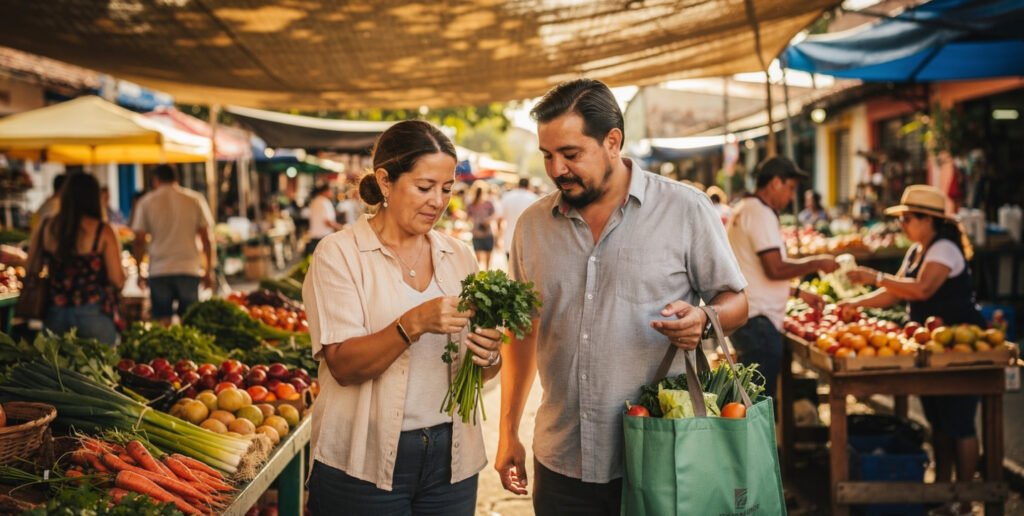
The outdoor farmers’ market is a weekly institution in virtually every Costa Rican city and town. Produce is fresh, prices are lower than supermarkets, and the social dimension running into neighbors, chatting with the same vendors you’ve bought from for years, is as important as the shopping itself. The feria is where the week resets.
🍽️
Sunday lunch — non-negotiable
Sunday lunch at the family home is the social centerpiece of the Costa Rican week. It is not optional. It is not casual. It is the gathering point for a social network that in any other country might require event planning here it simply happens, every week, because it has always happened and stopping it would require an explanation nobody wants to give.
⛪
Faith in the fabric
Whether practicing or not, most Costa Ricans move through a culture saturated with Catholic and evangelical reference points from the “Que Dios le bendiga” at the end of a phone call to the roadside shrines visible on every highway. Faith here is less a doctrinal position than a cultural texture, woven into daily language and social expectation.
The economics of ordinary life
Any honest account of daily life in Costa Rica has to include the economic dimension not to paint a picture of hardship, but because the financial pressures that shape daily decision-making are a real and defining part of the lived experience of most Costa Rican families.
The average Costa Rican salary varies widely by sector, but the middle class broadly defined as families who own or rent adequate housing, send their children to school, have some access to private healthcare to supplement the public system, and can occasionally afford a weekend trip or a dinner out is a real and substantial segment of the population. It is also a segment under real pressure. Housing costs in the greater metropolitan area have risen significantly faster than wages in recent years. The monthly CAJA contribution the mandatory social security payment that funds the public healthcare and pension system, is a significant line item in every worker’s budget. Fuel, groceries, school supplies, and the maintenance costs of a vehicle on roads that are hard on cars, these accumulate in ways that require careful management.
“The Costa Rican middle class is not struggling in the dramatic sense, but it is managing, carefully and constantly, in a way that the pura vida mythology tends to obscure.”
This financial navigation happens largely invisibly from the outside. Costa Ricans are not culturally inclined to discuss money difficulties openly, there is a social dignity ethic that keeps financial stress private. What you see on the surface is the warmth, the humor, the social ease. What it takes to maintain that surface is the part that most visitors never see, and that most Costa Ricans would not show them if they could.
What the public systems look like from inside them
Costa Rica’s public institutions healthcare, education, utilities are frequently cited in international comparisons as exceptional for a country at its income level. That reputation is earned. The CAJA healthcare system provides genuine universal coverage. The public school system is free and constitutionally protected. Life expectancy in Costa Rica exceeds that of the United States. These are real achievements and they matter enormously to the quality of daily life.
But navigating those systems from the inside requires a specific kind of patience. A CAJA appointment for a specialist can take months. Public school infrastructure varies dramatically between urban and rural zones. The bureaucracy that administers these services is not indifferent, it is understaffed and underfunded relative to the demand it serves. The Costa Rican who has learned to work within these systems, who knows which clinic to call, which window to go to, which document to bring in triplicate has acquired a practical knowledge that takes years to develop and is not available in any guide. Foreigners who encounter these systems expecting European efficiency are often surprised. Costa Ricans who encounter them are simply prepared.
The texture that doesn’t translate
There are aspects of daily life in Costa Rica that resist description precisely because they are experiential, the specific quality of a Tuesday morning in December when the dry season is beginning and the light is different and the air smells faintly of burning sugarcane from somewhere in the direction of Turrialba. The way a street sounds at six-thirty in the evening when the school buses have already passed and the dinner preparations are underway behind closed windows. The particular social ease of a soda at lunchtime when everyone in the room is a regular and nobody needs to explain themselves.
These are the things that constitute a place not its attractions, not its statistics, not its reputation in international indices. They are available to anyone who slows down enough to notice them. But they cannot be accessed on a tour. They require time, presence, and a willingness to occupy the ordinary alongside the people for whom the ordinary is home.
Costa Rica’s daily life is not extraordinary. That is precisely what makes it worth understanding. It is the life of a country that has made specific, considered choices about what to value community over individualism, warmth over efficiency, presence over productivity and that lives with the consequences of those choices every day, with eyes open and thermos in hand.
What this means for the visitor who wants to see it
The gap between the Costa Rica tourists experience and the Costa Rica locals inhabit is not unbridgeable. But crossing it requires a deliberate choice to step out of the visitor infrastructure, the tour operators, the resort shuttles, the English-language menus and into the spaces where daily life actually happens.
Take a public bus between cities instead of a shuttle van. Eat at the soda inside the mercado rather than the restaurant on the tourist strip. Shop at the Saturday feria instead of the hotel gift shop. Ask your host what they did last weekend, not what they recommend for the next one. Spend a Sunday afternoon in a neighborhood park and watch what a Sunday afternoon actually looks like for the families gathered there, the children on the swings, the couples on the benches, the older men playing chess, the woman selling chiverre candy from a cart near the entrance.
None of that requires a special itinerary. It requires only the decision to be curious about the life that surrounds the attractions rather than the attractions themselves. That curiosity is what separates tourism from travel and travel from the much rarer and more satisfying experience of actually having been somewhere.
Costa Rica is worth being in, not just visiting. The daily life of its people is the proof. You just have to be willing to look at it.
Continue Exploring Everyday Costa Rica
If you’re curious about what life is really like beyond the tourist attractions, these guides will help you understand Costa Rica from a local perspective:
• Costa Rican Culture Explained: An Honest Guide for Foreigners
• The Reality of Public Transportation in Costa Rica
• What Is Gallo Pinto and Why Costa Ricans Eat It Every Morning